
By Coach Dean Moskowitz
Parkinson's Exercise Class: What to Look For Before You Join
Health information, not medical advice. Talk with your doctor before starting a new exercise program.
Quick answer: A good Parkinson’s exercise class trains the things the disease actually takes: big (amplitude) movement, balance and stepping reactions, strength, rhythm, and voice. It offers seated and standing options for every exercise, keeps groups small enough for real attention, and is led by someone with Parkinson’s-specific training. Ask for a free trial class before committing — reputable programs offer one. To find classes near you, call the Parkinson’s Foundation Helpline at 1-800-4PD-INFO (1-800-473-4636).
Exercise classes for Parkinson’s have multiplied over the last decade, which is wonderful — and confusing. Boxing, dance, tai chi, cycling, PWR!, LSVT-based programs, generic senior fitness with “Parkinson’s” in the flyer. How do you tell a great one from a well-meaning one?
I’ve been running Parkinson’s classes for over ten years and have coached more than 500 people with the disease. Here’s the checklist I’d use if I were shopping for a class for my own family — including the parts where I’d walk out.
The eight things a good Parkinson’s class has
1. Amplitude training as a constant theme. Parkinson’s shrinks movement; a good class fights that in every exercise. You should hear the instructor demanding BIGGER — bigger steps, bigger reaches, fuller punches — all class long. This is the core principle behind LSVT BIG, and any Parkinson’s class that isn’t obsessed with it is missing the point.
2. Real balance and stepping-reaction work. Not just standing on one leg — quick steps in every direction, weight shifts, reaching outside your base, recovering from small perturbations. Falls happen from unplanned movements, so the training has to be unplanned too. (See fall prevention.)
3. Strength work. Sit-to-stands, pushing, pulling, carrying. Muscle is independence, and Parkinson’s classes that are all cardio and no resistance leave a hole.
4. Aerobic intensity that’s actually intense. Research interest in Parkinson’s exercise keeps pointing toward genuine effort mattering, not just going through motions. You should get warm, breathe hard, and feel like you worked. A class where nobody’s heart rate rises isn’t delivering the main ingredient. (My exercise guidelines article covers the 2.5-hours-a-week target.)
5. Rhythm and music. Beat helps Parkinson’s brains time movement — it’s one of the most reliable tricks in the book, and good classes use it deliberately. Here’s why rhythm works.
6. Voice activation. Counting out loud, calling out punches, shouting numbers. Parkinson’s quiets voices, and classes that make you use yours are sneaking in speech therapy. If a class is silent except for the instructor, that’s a missed opportunity.
7. Genuine modifications — seated options for everything. Every exercise should have a chair version offered without ceremony. Look at whether people who need to sit look included or sidelined. (Seated work is real work — see seated boxing.)
8. Community. The least measurable and possibly most important. Do people arrive early to talk? Stay after? Know each other’s names? Parkinson’s is isolating; the friendships in a good class are part of the treatment, not a bonus feature.
Questions to ask the instructor
- “What’s your Parkinson’s-specific training?” Look for LSVT BIG certification, PWR! training, Rock Steady-style boxing certification, Parkinson’s Foundation courses, or a physical therapy background. Enthusiasm without training is a caution flag.
- “How do you handle medication on/off times?” A knowledgeable instructor will already have asked you about this.
- “What if I freeze during class?” Listen for concrete cueing strategies — counting, rhythm, stepping over a line, weight shifts — not just “we’ll help.”
- “How many people per class, and is there help available?” Smaller is better; extra volunteers or assistants are a great sign.
- “What if I use a walker or wheelchair?” The answer should be immediate and comfortable.
- “Can I try a class free?” Yes is the only good answer.
- “What do you do if someone falls?” A good program has thought about it and will tell you plainly.
Warning signs
- Generic senior fitness wearing a Parkinson’s label. If the class is identical to the one before it with a different flyer, it’s not built for PD.
- No modifications, or modifications that feel like exclusion.
- Instructor who can’t answer basic Parkinson’s questions.
- Overpromising. Anyone claiming a class will “reverse” or “cure” Parkinson’s is either uninformed or dishonest. Exercise is powerful and worth doing — it isn’t a cure, and the good programs say so plainly.
- Too big to be safe. If one instructor is watching thirty unsteady people, nobody’s actually being watched.
- A hard sell for a long contract before you’ve taken a single class.
The types of Parkinson’s classes you’ll find
Non-contact boxing (what we do): footwork, punches, pads, and bags — trains amplitude, balance reactions, strength, rhythm, and voice in one package, with the added benefit that people actually look forward to it. What a first class looks like · why boxing helps.
PWR! Moves and LSVT-based classes — built directly on the amplitude research, often taught by PTs. Excellent, especially early after diagnosis.
Dance for PD-style classes — music, rhythm, big movement, and joy. Wonderful for people who’d never set foot in a gym.
Tai chi — gentle, strong balance evidence, easy on joints. A good complement rather than a complete program.
Cycling programs — strong aerobic option, research interest in high-cadence “forced exercise”. Doesn’t train balance, so pair it with something standing.
Aquatic classes — safe and joint-friendly; won’t build standing balance, so again, pair it.
Most people do best combining two: something standing and dynamic (boxing, dance, PWR!) plus something aerobic (cycling, walking, swimming).
How to find classes near you
- Parkinson’s Foundation Helpline: 1-800-4PD-INFO (1-800-473-4636) — free, staffed weekdays in English and Spanish, and the single best starting point anywhere in the country. They also list virtual classes.
- Your neurologist or movement disorder clinic — they know the local landscape.
- Local Parkinson’s organizations. In Los Angeles, Parkinson’s Community Los Angeles (310-880-3143) and the American Parkinson Disease Association’s Santa Monica center (310-582-7641) both maintain program lists. My support groups article has more LA resources.
- Hospital rehab and community education departments.
- Online classes if geography or transportation is the obstacle — the Foundation hosts free virtual sessions, and our online program is built for exactly this.
Come try ours
We run Parkinson’s boxing classes at four locations across Los Angeles and Ventura County — Santa Monica, Lake Balboa, Woodland Hills, and Thousand Oaks. Every exercise has a seated version, gloves are provided, and the community is the part people stay for. Our classes have been featured by the Parkinson’s Foundation, and I also run a free monthly support group on Zoom for people with Parkinson’s and their care partners.
First class free, always. Schedule here or call or text 747-234-1115. Use the checklist on us — I’d rather you ask hard questions and choose well, even if you choose somewhere else.
Dean Moskowitz is the head coach at Boxing for Balance. He has spent more than ten years helping over 500 people with Parkinson’s — and hundreds of older adults — build strength through non-contact boxing and exercise, in classes across Los Angeles and Ventura County.
Sources: Parkinson’s Foundation — Exercise · Parkinson’s Foundation — Exercise Recommendations · LSVT-BIG and proprioceptive recalibration — BMC Neurology
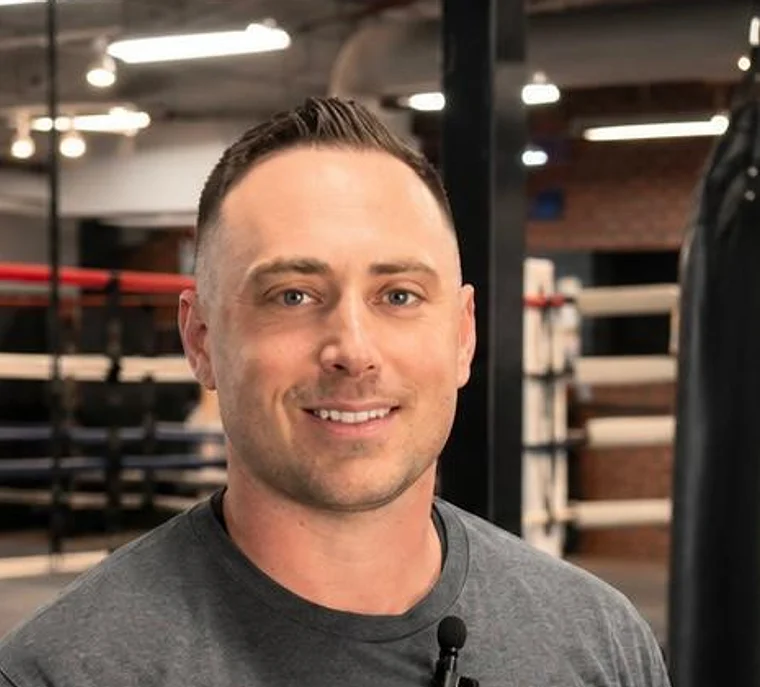
Coach Dean Moskowitz
Owner / Coach, Boxing for Balance — 500+ people with Parkinson's coached