
By Coach Dean Moskowitz
Parkinson's and Loneliness: The Symptom Nobody Warns You About
Health information, not medical advice. Talk with your doctor before starting a new exercise program.
Quick answer: Loneliness is common in Parkinson’s and it is not trivial. In a survey published in npj Parkinson’s Disease, people with Parkinson’s who reported being lonely also reported 55% greater symptom severity than those who weren’t, while those who said they had a lot of friends reported 21% fewer symptoms. The researchers were honest that they can’t say which causes which. What helps is specific and doable: a support group, a standing weekly commitment with other people, telling one person the truth, and treating depression if it’s there. You do not have to fix this by becoming a different personality.
Nobody hands you a pamphlet about this part.
At diagnosis you get told about tremor, about medication timing, about exercise. Real, useful information. What nobody sits you down and says is: within a year, your phone is going to ring less.
I’ve coached more than 500 people with Parkinson’s over the past decade, and this is the pattern I see most reliably — more reliably than any symptom. Somebody arrives at their first class, and in the parking lot afterward their spouse tells me quietly that this is the first thing they’ve agreed to do in eight months.
So let’s talk about the part nobody warns you about, what the research actually says, and what genuinely helps. Some of what follows is uncomfortable. I think you’d rather have it straight.
What the research actually shows
A survey of people with Parkinson’s published in npj Parkinson’s Disease in 2020 asked about social connection alongside symptom severity and quality of life. Two findings stand out:
- People who reported being lonely reported 55% greater symptom severity than people who didn’t.
- People who reported having a lot of friends reported 21% fewer symptoms than those with few or none.
Both results were statistically significant. But here is the part I insist on repeating, because the researchers said it themselves: it is not clear which direction this runs. Does loneliness worsen Parkinson’s? Does Parkinson’s — the fatigue, the embarrassment, the difficulty getting out — drive the loneliness? Almost certainly some of both, tangled together.
What I find striking is that the recommendation doesn’t depend on solving that puzzle. The authors’ conclusion was plain: keep people with Parkinson’s connected, and use support groups and social connection deliberately to do it.
Zoom out from Parkinson’s and the picture gets more forceful. A meta-analysis in PLoS Medicine pooled 148 studies covering more than 308,000 people and found that those with stronger social relationships had a 50% greater likelihood of survival over the follow-up periods studied. That’s not a Parkinson’s finding — it’s a human finding. Social connection sits alongside the things we already treat as medical.
And there’s a harder study worth knowing about, though I want to frame it carefully. Researchers followed 491,603 people in the UK for about 15 years and found that those who reported being lonely had a higher risk of developing Parkinson’s — about 25% higher after accounting for depression, genetics, physical activity, and a long list of other factors (JAMA Neurology, 2023). If you already have Parkinson’s, this is not about you, and it is not your fault. Nobody gave themselves this disease by not getting out enough. I mention it only because it tells us the connection between isolation and this disease runs deeper than anyone assumed.
Why the world shrinks
Understanding the mechanics helps, because it stops you blaming yourself for something largely structural.
Driving gets harder or stops. For a lot of people this is the single biggest one. Your social life was built on the assumption you could get in a car.
Friends don’t know what to say. So they say nothing, and then too much time passes and now it’s awkward, and then they really say nothing. Most of them aren’t rejecting you. They’re cowards about illness, like most of us are until we’ve been through it.
The voice gets quieter. Parkinson’s softens speech, often before the person notices. In a noisy restaurant you get asked to repeat yourself twice and decide it’s easier to stay quiet. Then it’s easier not to go.
Movement in public feels exposed. Freezing in a doorway with people behind you. Tremor showing up when a stranger watches. Taking longer at the register. None of it is dangerous; all of it is exhausting.
Fatigue is real and invisible. Parkinson’s fatigue isn’t sleepiness — it’s a depletion that makes a dinner invitation feel like a mountain.
Depression and apathy are part of the disease. Not weakness, not attitude — genuine, common, treatable symptoms of Parkinson’s. Apathy in particular is cruel, because it removes the wanting to see people, and from the outside it looks like choosing to withdraw.
Read that list again and notice how much of it is logistics and biology rather than character. You did not become antisocial. Your circumstances got harder while your energy got smaller.
The uncomfortable finding, and why I’m telling you anyway
Here’s where I have to be honest against my own interest.
A 2026 study in the Journal of Neurologic Physical Therapy surveyed 231 people with Parkinson’s who were already attending community-based exercise classes — people like my members, showing up regularly, an average of over two years into their program. You’d expect loneliness to be solved in that group.
Almost a third of them — 32.9% — still scored in the lonely range.
The researchers put it plainly: loneliness was present even among people actively engaged with an exercise community. They also found loneliness tracked with functional independence, mobility, and quality of life, and suggested that instructors like me should actually screen for it rather than assume the room is doing the work.
I could have left that study out of this article. I’m including it because it corrects something I used to believe. Attendance is not the same as connection. You can come to class three times a week, do every drill, leave without anyone learning anything true about you, and still drive home lonely. The room creates the opportunity. It doesn’t automatically cash it.
Which means the practical advice has to be better than “join something.”
What actually helps
Pick one thing that meets on a schedule, and let the schedule carry you. Motivation is unreliable, especially with apathy in the mix. A class at 10 a.m. on Mondays doesn’t require you to feel like going. My members who last aren’t the most motivated — they’re the ones whose Tuesday is the boxing day, permanently.
Choose a room where the diagnosis is already known. Enormous relief lives in not having to explain yourself. That’s the whole design of a Parkinson’s support group — and it’s why I run a free one on Zoom on the last Tuesday of every month, open to care partners too, with no requirement to box or be a member of anything.
Say one true thing to one person this week. Not a public announcement. One person, one honest sentence about how it’s actually going. The isolation of Parkinson’s is only partly about how many people are in the room; a lot of it is about how much of yourself you’ve stopped showing.
Get the depression treated, if it’s there. If you’ve lost interest in things you used to love, tell your neurologist plainly. Depression and apathy in Parkinson’s are treatable, and untreated they will quietly undo every social plan you make. This is the highest-leverage item on this list and the one people skip.
Use the phone when the car isn’t an option. A standing weekly call is not a consolation prize. Same time, same person, every week.
Let people help you get there. Rides are the most common unsolved problem I see. Most people have someone who would happily drive them and has never been asked, because asking feels like admitting something.
Care partners: this is about you too. Spouses often become more isolated than the person with the diagnosis — they lose their own social life while absorbing a second one. Every good support group welcomes you, including ours. I wrote more for you in Caregiver’s Corner.
Where to find people
- Parkinson’s Foundation Helpline: 1-800-4PD-INFO (1-800-473-4636) — free, staffed weekdays 9 a.m.–7 p.m. Eastern in English and Spanish. Tell them your zip code and ask what’s near you. This is the single best call to make anywhere in the country.
- Parkinson’s Community Los Angeles: 310-880-3143 — support groups, newly diagnosed programs, care partner programs.
- American Parkinson Disease Association, Santa Monica: 310-582-7641 — an information and referral center staffed by a licensed social worker.
- Our free monthly support group — last Tuesday, 2 p.m. Pacific, on Zoom, for people with Parkinson’s and care partners. Details here or text me at 747-234-1115.
- A class, if you’re near us. Four locations across LA and Ventura County, first one free. Come for the exercise; the people are the part that keeps members coming back for years. What a first class is like.
The honest close
I’m a boxing coach. I’m not going to tell you a support group cures Parkinson’s, and the research above doesn’t say that either.
What I’ll tell you is what I watch happen, most weeks, in a gym in Los Angeles. Somebody comes in for the first time convinced they’re the only one this is happening to. Ninety minutes later they’re standing by the door talking to a stranger about medication timing, and they don’t want to leave. Nothing about their diagnosis changed that morning. The aloneness did.
The disease is going to ask a lot of you. Carrying it by yourself is the one part that isn’t required.
Dean Moskowitz is the head coach at Boxing for Balance. A lifelong martial artist and former MMA fighter, he has spent more than ten years helping over 500 people with Parkinson’s — and hundreds of older adults — build strength through non-contact boxing and exercise, in classes across Los Angeles and Ventura County. If you have lost interest in things you used to enjoy, please tell your doctor — depression and apathy in Parkinson’s are common and treatable.
Sources: Social isolation and Parkinson severity and quality of life (npj Parkinson’s Disease, 2020) · Loneliness in people with Parkinson disease in community-based exercise (J Neurol Phys Ther, 2026) · Social relationships and mortality risk — meta-analysis of 148 studies (PLoS Medicine, 2010) · Loneliness and risk of Parkinson disease (JAMA Neurology, 2023) · Parkinson’s Foundation Helpline
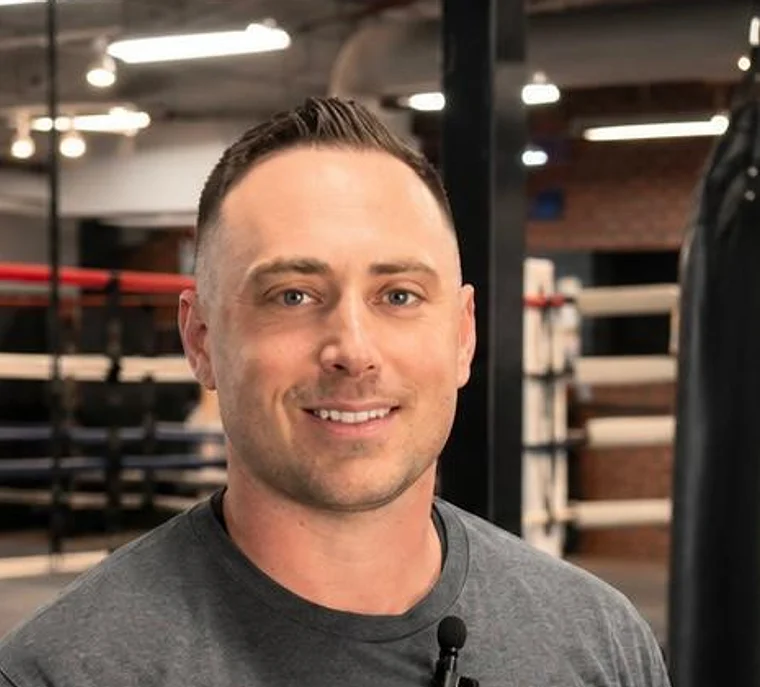
Coach Dean Moskowitz
Owner / Coach, Boxing for Balance — 500+ people with Parkinson's coached