
By Coach Dean Moskowitz
LSVT BIG Exercises: How Thinking Big Helps Parkinson's
Health information, not medical advice. Talk with your doctor before starting a new exercise program.
Quick answer: LSVT BIG is a physical therapy program for Parkinson’s built around one idea: practice movements that feel too big, because Parkinson’s quietly shrinks your sense of normal movement. The full program is 16 one-hour sessions with a certified therapist — four days a week for four weeks — followed by daily home practice. Research shows it can improve movement size, walking, and quality of life.
Parkinson’s plays a quiet trick on the body. It makes movements smaller — shorter steps, softer voice, smaller handwriting — while convincing your brain that everything is normal-sized. When a therapist asks someone with Parkinson’s to take what feels like a giant, exaggerated step, video usually shows something surprising: the step looks completely normal.
That gap between how movement feels and how it looks is the problem LSVT BIG was built to solve. And the solution sounds almost too simple: practice moving BIG, over and over, until big feels normal again.
What is LSVT BIG, exactly?
LSVT stands for Lee Silverman Voice Treatment. The original program, LSVT LOUD, was created in 1987 to help a woman named Mrs. Lee Silverman speak louder — Parkinson’s had shrunk her voice the same way it shrinks steps. It worked well enough that researchers later asked: if practicing LOUD restores the voice, could practicing BIG restore whole-body movement? LSVT BIG is the answer.
The formal program is specific:
- 16 sessions — one hour each, four days a week, for four weeks
- One-on-one with a physical or occupational therapist certified in LSVT BIG
- Daily homework — the exercises repeat at home, every day, during and after the program
- One instruction — every movement is done at maximum amplitude. Not fast. Not hard. BIG.
A study in BMC Neurology found that after four weeks of LSVT BIG, participants’ ability to sense their own movements — called proprioception — measurably improved, and kept improving with continued practice. Quality of life scores improved too. In plain terms: the training helps recalibrate the body’s internal ruler.
What the exercises look like
The daily core of LSVT BIG is a set of “maximal daily exercises.” A certified therapist tailors them to you, but the standard set includes:
Seated exercises:
- Floor-to-ceiling reaches. Sitting tall, sweep both arms from down near the floor up as high as possible, stretching the whole body upward. Hold the top.
- Side-to-side reaches. One arm reaches far across your body and out to the side, twisting the trunk, as big as possible each way.
Standing exercises:
- Forward step and reach. A big step forward while both arms drive forward and up. Then back to start. The step is bigger than feels natural — that is the point.
- Sideways step and reach. A wide step to the side with arms sweeping wide.
- Backward step and reach. A large, controlled step back with arms reaching back.
Each movement is repeated many times, every single day, always at “your biggest.” The therapist coaches loudly and constantly — “BIG! BIGGER!” — because your own sense of big is exactly what cannot be trusted yet.
Alongside the core exercises, sessions practice everyday tasks the same way: standing up BIG, turning BIG, buttoning a shirt with big deliberate motions, walking with long steps and big arm swings. Whatever tasks matter most in your life get the BIG treatment.
Does it work?
The research is encouraging, with honest limits. The BMC Neurology study above showed improved movement perception and quality of life. Other studies have found better walking speed, bigger steps, and improved scores on standard Parkinson’s motor tests. European physical therapy guidelines for Parkinson’s recommend the approach for improving walking, balance, and transfers, while noting the evidence base is still modest in size — most studies are small.
Two things are clear from both research and experience:
- Intensity is the ingredient. Four days a week for four weeks, plus daily homework, is a lot. That dose is deliberate — Parkinson’s needs frequent, repeated, effortful practice to change movement patterns. Gentle once-a-week stretching does not create the same recalibration.
- It fades without practice. Like all exercise benefits, BIG movements stay only as long as you keep making them. The four weeks are the beginning, never the end.
How to actually get LSVT BIG
LSVT BIG requires a certified clinician — this is a therapy program, not a video series. Here is the path:
- Ask your neurologist for a referral to physical therapy, mentioning LSVT BIG by name.
- Find a certified therapist through the LSVT Global website’s clinician directory. Los Angeles and Ventura County have multiple certified providers.
- Check insurance. Because LSVT BIG is delivered as physical/occupational therapy with a diagnosis code, Medicare and most insurance typically cover it like any other PT — but confirm your visit limits, since the program uses 16 of them.
What to do after (or alongside) the program
This is where we can speak from ten years of experience: the people who keep their gains are the ones who fold big movement into something they do every week, permanently, with other people.
The “think BIG” principle runs through every class we teach at Boxing for Balance. A boxing punch is a full-body amplitude exercise — reach farther, step wider, turn more. Our coaches cue big movement constantly, the same way an LSVT therapist does, and the group setting makes people push bigger than they would alone. Many of our members come to us straight from finishing LSVT BIG, on their therapist’s suggestion, to keep the practice alive. See our Parkinson’s boxing classes.
Whatever you choose — our classes, dance, tai chi, a home routine — the rule is the same. Big, often, forever. Parkinson’s does not take days off from shrinking movement, so the practice of enlarging it cannot take months off either.
Frequently asked questions
Can I just do LSVT BIG exercises at home from videos? You can practice big movements at home, and you should. But the formal program’s results come from a certified therapist calibrating your “big,” correcting you in real time, and pushing past your internal sense of normal. Do both: get the program if you can, and practice daily regardless.
Is LSVT BIG only for early Parkinson’s? It is studied most in early and middle stages, and some evidence suggests earlier is better. But therapists adapt it across stages, including seated versions. Ask a certified provider what fits your situation.
How is LSVT BIG different from regular physical therapy? Regular PT addresses specific problems — a weak hip, a stiff shoulder. LSVT BIG retrains one thing relentlessly: movement size. The single focus, high frequency, and constant maximum effort are what set it apart.
What does it cost? With insurance or Medicare covering PT visits, your cost is typically your normal copay per session, times 16. Without coverage, cash rates vary by clinic — ask directly.
Dean Moskowitz is the head coach at Boxing for Balance. He has worked with more than 500 people with Parkinson’s over the past decade in classes across Los Angeles and Ventura County, many of them graduates of LSVT BIG keeping their big movement alive. Talk with your doctor or physical therapist about whether LSVT BIG fits your treatment plan.
Sources: LSVT-BIG and proprioceptive recalibration — BMC Neurology · Parkinson’s Foundation — Exercise
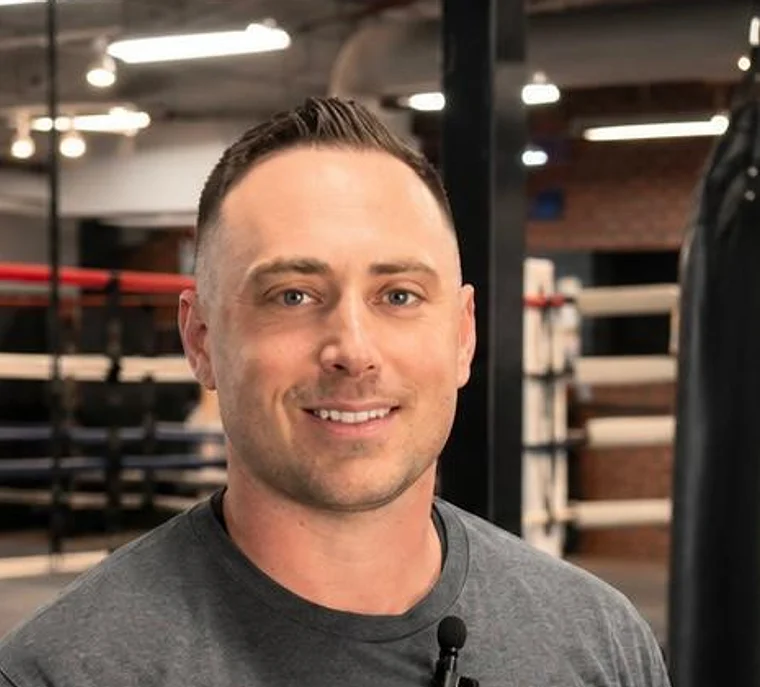
Coach Dean Moskowitz
Owner / Coach, Boxing for Balance — 500+ people with Parkinson's coached