
By Coach Dean Moskowitz
Why Non-Contact Boxing Helps Parkinson's: The Mechanics
Health information, not medical advice. Talk with your doctor before starting a new exercise program.
Quick answer: Boxing training happens to attack several things Parkinson’s specifically damages, all in one hour: it forces big movements against the shrinking Parkinson’s causes, it demands dual-tasking (moving while thinking), it runs on rhythm, which helps bypass the brain’s faltering internal timing, and it trains stepping reactions — the fast, unplanned foot movements that stop a stumble becoming a fall. This post is about those mechanisms. For the honest look at how strong the evidence is, read Is boxing good for Parkinson’s?
After a decade of coaching people with Parkinson’s, here is the short version of why I use boxing rather than anything else.
It isn’t that boxing is magic. It’s that Parkinson’s takes a specific and predictable set of things — movement size, automatic timing, balance reactions, the ability to move and think at once — and boxing training happens to hammer every one of those, in an hour that people actually enjoy.
Let me take them one at a time.
1. Parkinson’s shrinks movement. Boxing makes it big again.
Parkinson’s makes movements small. Shorter steps. Softer voice. Smaller handwriting. Smaller reach. The clinical term is bradykinesia, and the cruel part is that it recalibrates your sense of normal — a shrunken movement feels normal-sized from the inside.
Boxing training pushes the other way, constantly. Every punch is a big, deliberate, full-extension movement. When I’m shouting “BIGGER” at somebody for the fortieth time in a class, that’s the entire treatment principle in one word.
This is the same idea behind LSVT BIG, the certified amplitude-based therapy program. A study in BMC Neurology found that after four weeks of LSVT BIG, participants’ proprioception — their sense of where their own body is in space — measurably improved, and kept improving with continued practice. Quality of life scores improved too.
Worth being straight about the size of that study: the intervention group was 11 people. It’s a mechanism study, not proof of broad efficacy, and most research in this area is small. But the underlying principle — practice exaggerated movement until normal-sized feels normal again — is well established in Parkinson’s rehabilitation. I break down the approach in my LSVT BIG guide.
Every punch thrown at full extension is amplitude training wearing boxing gloves.
2. Your brain trains as hard as your body
Boxing combinations are rhythm and memory work. Jab, cross, hook — in order, on time, while moving your feet, while I change the count on you.
That’s dual-task training: doing something physical and something cognitive at the same time. It matters for Parkinson’s because the disease damages automatic movement. Healthy brains walk without thinking about walking. Parkinson’s forces walking back into conscious attention — which is exactly why people freeze in doorways, or stop walking when someone asks them a question.
A 2024 systematic review and meta-analysis in Brain Sciences pooled 14 randomised controlled trials covering 548 people with Parkinson’s and compared dual-task training against ordinary single-task training. Dual-task training came out ahead for dual-task walking speed, stride length, cadence, and quality of life.
The honest caveat, which the authors state plainly: the certainty of that evidence is rated low to very low. The direction is encouraging and consistent; the confidence is not high. It also didn’t improve balance confidence.
In practice this is why I keep changing the combination on people rather than letting a class become choreography they can run on autopilot. Autopilot is the thing Parkinson’s took. Rebuilding it means training in the space where it’s hard.
3. Rhythm gets in when instructions can’t
Every class I run has music, and it isn’t for atmosphere.
Parkinson’s damages the brain circuits that handle internal movement timing. But a strong external beat gives the motor system a different timekeeper to lock onto — one that doesn’t depend on the damaged machinery. Researchers call it rhythmic auditory stimulation, and walking to a steady beat has been shown to improve walking speed and step length while the beat is playing.
You can watch this work in real time. Somebody frozen in a doorway starts moving again when a person counts “one-two-THREE” at them. The beat reaches the muscles when the intention can’t. I wrote about the whole phenomenon in Music Therapy for Parkinson’s.
Punching on a beat is that same principle, done for an hour, for fun.
4. Footwork is fall prevention in disguise
Here’s the mechanism I think is most underrated.
Real falls don’t happen during careful, planned movement. They happen when something unexpected shifts your weight and you have half a second to get a foot down in the right place. That’s a reaction, and reactions have to be trained as reactions.
Boxing footwork is exactly that training: quick steps forward, back, and sideways; weight shifting with every punch; pivots; reacting to a pad that moved. Add the fact that the CDC reports about one in four adults 65 and older falls each year, and you can see why I treat footwork as the most medically serious part of class, even though it looks like the least.
Most fall-prevention programs train balance by having you hold still. Boxing trains it by making you move badly on purpose and recover.
5. And you won’t do it alone
The exercise matters, but so does the room.
Training beside people fighting the same fight turns a workout into a team — and that team quickly becomes a family. It’s why people keep showing up, and consistency is where results come from. It’s also not a soft benefit: in a survey published in npj Parkinson’s Disease, people with Parkinson’s who reported being lonely also reported 55% greater symptom severity than those who weren’t.
I’ll add the same caution I put everywhere else: attending a class isn’t automatically the same as being connected. You have to actually talk to somebody. More on that here.
What this post is not
This is about how boxing training targets Parkinson’s — the mechanisms, and why the hour is built the way it is.
It is deliberately not a claim that boxing beats other exercise. When you pool all the trials, that case is genuinely unsettled, and two systematic reviews published months apart reached different conclusions. I wrote that up honestly, including the study that doesn’t favor us, in Is boxing good for Parkinson’s? What the research says.
What I’d say with confidence: boxing delivers amplitude, dual-tasking, rhythm, balance reactions, strength, and community in one session that people look forward to. Whether that beats an equally well-designed program you’d enjoy just as much, I don’t know. Whether it beats the program you quit in March — yes.
Want to feel it for yourself? Your first class is free — schedule one here or try the online program from home.
Dean Moskowitz is the head coach at Boxing for Balance. A lifelong martial artist and former MMA fighter, he has spent more than ten years helping over 500 people with Parkinson’s — and hundreds of older adults — build strength through non-contact boxing and exercise, in classes across Los Angeles and Ventura County.
Sources: LSVT-BIG and proprioceptive recalibration (BMC Neurology, 2020) · Dual-task vs single-task gait training in Parkinson’s — systematic review and meta-analysis (Brain Sciences, 2024) · Social isolation and Parkinson severity (npj Parkinson’s Disease, 2020) · CDC — Facts about falls
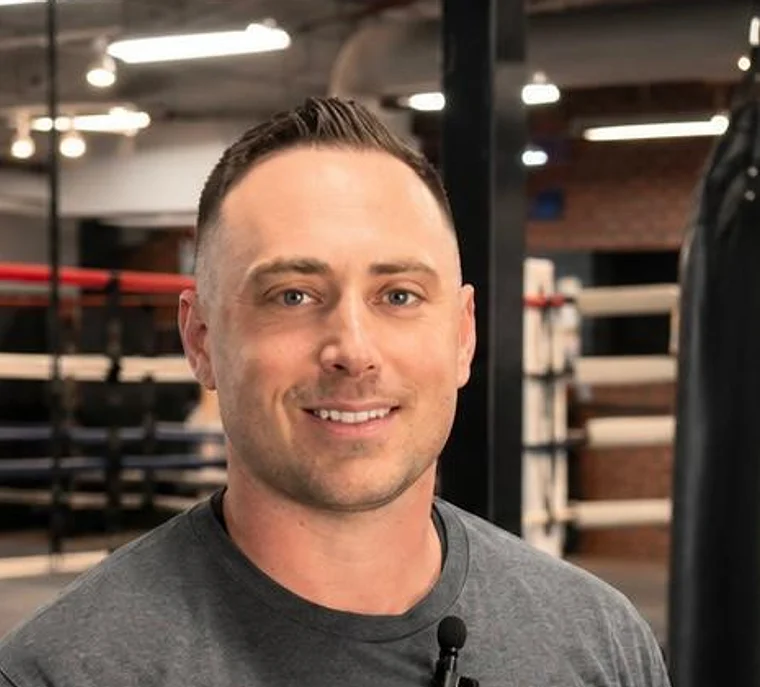
Coach Dean Moskowitz
Owner / Coach, Boxing for Balance — 500+ people with Parkinson's coached