
By Coach Dean Moskowitz
Boxing Classes for Seniors: What to Expect Your First Day
Health information, not medical advice. Talk with your doctor before starting a new exercise program.
Quick answer: Senior boxing classes are non-contact — nobody gets punched, ever. You hit pads and bags, not people. A typical class runs 45 to 60 minutes: warm-up, footwork, punch combinations on pads or heavy bags, strength and balance work, then a cool-down. Every exercise has a seated version. Wear comfortable clothes and closed-toe shoes; gloves are provided. Your first class with us is free — call 747-234-1115 or schedule here.
The most common thing I hear from a new member’s family is some version of: “Wait — boxing? At 78?”
Then they come watch, and about ten minutes in, the questions change. Now it’s “how did she learn that combination?” and “he hasn’t stood that straight in a year.”
I’ve been teaching non-contact boxing to seniors for over a decade — more than 500 people with Parkinson’s, plus hundreds of older adults who came for balance, strength, or something more interesting than a stationary bike. Here’s exactly what a class is, so you can decide with real information instead of a movie in your head.
First, the thing everyone worries about: nobody gets hit
Let’s kill this one immediately. Non-contact boxing means no sparring, no partner punching, no contact of any kind between people. You punch focus mitts (the flat pads a coach holds), heavy bags, or the air. That’s it. Nobody is going to hit you. Nobody is going to ask you to hit a person. There’s no ring, no competition, no headgear-and-mouthguard business.
What you get is boxing’s training — the footwork, the punches, the rhythm, the conditioning — which turns out to be a nearly perfect exercise system for older bodies. All the benefit, none of the concussions.
What a class actually looks like, minute by minute
Warm-up (10 minutes). Marching, shoulder rolls, arm circles, gentle twists, ankle work. Music’s on from the first minute — rhythm does real work for aging and Parkinson’s brains, and it also loosens the room socially. People talk during warm-up. That’s intentional.
Footwork and stance (10 minutes). How to stand balanced — feet apart, knees soft, weight centered — then moving: forward, back, side to side, pivoting. This is the part that quietly does the most for fall prevention, because it’s training your feet to move quickly and land correctly. We do it holding a chair or bar if that’s what today calls for.
Punches and combinations (15–20 minutes). The jab, the cross, the hook, the uppercut — taught one at a time, then strung together. You’ll work pads with a coach or partner up on the heavy bags. This is where the class gets loud and where I do most of my coaching: bigger, reach, breathe out, again. Punching big is amplitude training, the same principle behind LSVT BIG therapy — and unlike most exercises, it’s genuinely satisfying.
Strength and balance work (10 minutes). Sit-to-stands, wall push-ups, band work, single-leg practice, core drills. The unglamorous stuff that makes daily life easier.
Cool-down and stretching (5 minutes). Breathing, gentle stretches, and — always — some talking. A lot of the value of class happens in these five minutes.
“But I can’t stand for an hour” (and other honest concerns)
Every single exercise has a seated version. I teach seated boxing regularly in senior communities and in class, and it is not a lesser workout — punching hard from a chair will absolutely wear you out. Wheelchair users box in my classes. People stand for part and sit for part. Nobody keeps score.
“I’m not coordinated.” Neither was almost anyone on day one. Combinations are taught one punch at a time and you’ll be surprised how fast your body picks up patterns — that’s the brain learning, which is part of the medicine.
“I haven’t exercised in years.” Perfect. That’s the most common starting point in the room, and it’s why the first class is free — so you can find out what your body can do without committing to anything.
“I’ll be the oldest one there.” Our members range from about 60 into their 90s. In the communities where I teach, some are past 100.
“I have Parkinson’s.” Then you’re in the group that boxing was popularized for — the research on why it helps is worth reading, and we build classes around exactly those needs.
What to bring, what to wear
- Closed-toe athletic shoes. The single non-negotiable. No sandals, no slick soles.
- Comfortable clothes you can move in. No special gear.
- Water. You’ll want it.
- Hand wraps or gloves: we provide them. Bring your own once you’re hooked, and you will be.
- Your medication timing in mind — if you have Parkinson’s, come during an “on” period when your body responds best.
- Your questions. Ask them. Ask me about anything that hurts, worries you, or seems impossible.
What the first day feels like
You’ll be nervous walking in. Everyone is. Someone will introduce themselves within thirty seconds because that’s the culture we’ve built, and by the time the music starts you’ll have forgotten to be nervous.
You will punch a pad and it will make a sound you didn’t expect to be able to make. You’ll probably laugh. Most people do — there is something about hitting things that turns adults back into kids for a second.
You’ll be tired after. You’ll likely sleep well that night. And somewhere in the next few days, when you stand up from a chair or reach for a shelf, you’ll notice it took slightly less thought than it used to.
That’s the whole pitch, really. Not “boxing will cure things” — I don’t say that and you should be skeptical of anyone who does. Just: this is exercise you’ll actually keep doing, and the strength, balance, and confidence come along for the ride. The research on exercise and Parkinson’s is clear that consistency is what matters most, and consistency is a motivation problem more than a physiology one. Boxing solves the motivation problem better than anything I’ve found in ten years of trying.
Coming to see us
We run classes at four locations across Los Angeles and Ventura County — Santa Monica, Lake Balboa, Woodland Hills, and Thousand Oaks. Our Parkinson’s program page has the details, private training is available if a group isn’t your speed, and if you’re not local, the online program brings the same workouts to your living room.
Your first class is free. No contract, no sales pitch afterward, no obligation of any kind. Come see what your body can still do — schedule here, or just call or text me at 747-234-1115.
Bring the shoes. I’ll bring the gloves.
Dean Moskowitz is the head coach at Boxing for Balance. He has spent more than ten years helping over 500 people with Parkinson’s — and hundreds of older adults — build strength through non-contact boxing and exercise, in classes across Los Angeles and Ventura County.
Sources: Parkinson’s Foundation — Exercise Recommendations · CDC physical activity guidance for older adults · CDC — Facts about falls
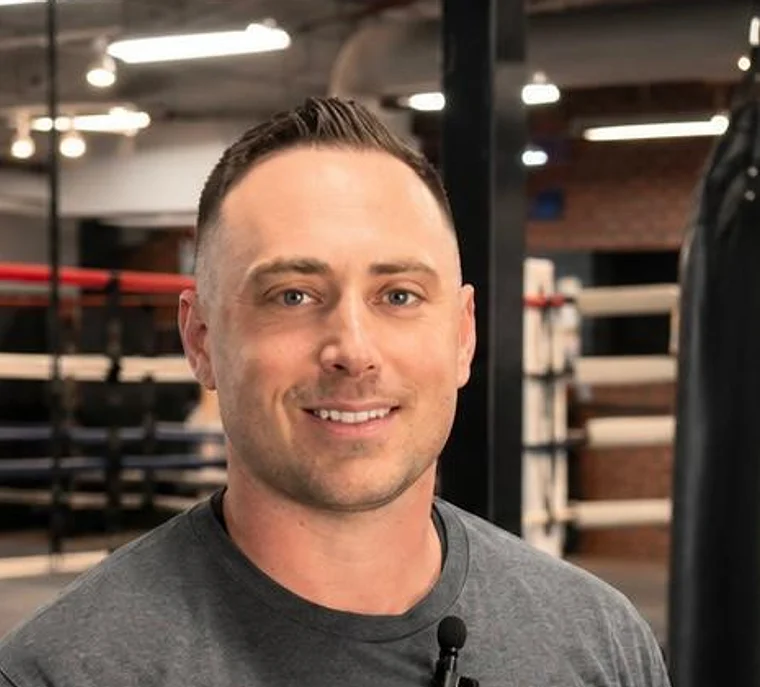
Coach Dean Moskowitz
Owner / Coach, Boxing for Balance — 500+ people with Parkinson's coached