By Coach Dean Moskowitz
How Do You Become a Rock Steady Boxing® Coach? Certification, Explained
Health information, not medical advice. Talk with your doctor before starting a new exercise program.
Quick answer: Rock Steady Boxing® certification comes from Rock Steady Boxing, Inc., the Indianapolis nonprofit that owns the program — not from any affiliate gym, including mine. To become a certified Head Coach you need a qualifying professional background (a medical license, an NCCA-approved fitness certification, or an exercise-science degree), a connection to an RSB affiliate location, and their training: roughly 11 hours of online coursework plus a two-day in-person camp, currently $899. There are lower tiers too, all the way down to a free volunteer track. Below I’ll walk through the whole ladder — the real costs, the prerequisites, and what nobody tells you about the job itself — from someone who coaches this curriculum every week across four affiliate gyms.
Written by an official affiliate coach
People land on this question from very different places, so let me name the three I hear most: fitness professionals and physical therapists who keep meeting clients with Parkinson’s and want a real curriculum for them; gym owners wondering whether to bring the program to their community; and — more often than you’d think — family members of someone with Parkinson’s who watched a class change their person and thought, I want to be part of this. There’s a path for each of you, and they cost very different amounts, so it’s worth getting the structure right.
First, understand what certification actually is
Rock Steady Boxing is a licensed curriculum, not a franchise you can buy off the shelf or a weekend workshop anyone can attend. Rock Steady Boxing, Inc. is a 501(c)(3) nonprofit headquartered in Indianapolis, and it controls two things tightly: who may teach the curriculum (certified coaches) and where it may be taught (licensed affiliate locations). Both matter. A certified coach can’t run Rock Steady Boxing® classes out of a random park — group classes can only be delivered at an official affiliate location. That’s not bureaucracy for its own sake; it’s how a program serving people with a progressive neurological condition keeps its quality floor high across hundreds of gyms.
That’s also why you should be wary of anything that markets itself as “Parkinson’s boxing certification” from anyone else while borrowing the Rock Steady name. The real thing comes from one place.
The prerequisites
To become a certified Head Coach — the person allowed to lead classes and anchor an affiliate — RSB currently requires that you hold at least one of the following, per their official coach training page:
- A medical professional license (physical therapists and occupational therapists are common), or
- An NCCA-approved fitness professional certification (the accreditation standard behind respected personal-training certs), or
- A degree in an exercise-science-related field.
Notice what’s not on the list: a boxing background. You don’t need to have fought — I did, and it helps me demonstrate mechanics, but the curriculum is built so that a sharp exercise professional can learn to teach the boxing elements. What can’t be taught in a weekend is the professional judgment to train medically complex people safely. That’s why the prerequisites lean clinical.
The training itself
Head Coach certification is a two-part process: approximately 11 hours of online coursework, followed by a two-day in-person training camp. Camps run several times a year, mostly at RSB headquarters in Indianapolis, with occasional additional sites — their 2026 calendar includes Indianapolis dates in June, July, October, and November, plus Huntsville, Alabama in August and international dates in the Netherlands.
The online portion covers the Parkinson’s knowledge — what the disease does to movement, cognition, and voice, and why the curriculum attacks each of those. The in-person camp is where it becomes real: you coach, you get coached, you learn the modifications that let a boxer at any stage train safely, and you leave with a network of coaches you’ll lean on for years.
What it costs
Here are the current published figures from RSB’s site (they note pricing is subject to change annually — always confirm on their page before budgeting):
- New affiliate program fee: $1,000 per year (rising to $1,036/year for affiliates starting after May 1, 2026)
- Head Coach Training & Camp: $899 (online + in-person)
- Coach — can lead group classes: $599
- Assistant Coach — supports but can’t lead: $149
- Volunteer: free, with its own training camp
- Recertification: $75 every two years
Two things jump out. First, the ladder is genuinely accessible — if you just want to help, the volunteer track costs nothing, and I wrote a whole post about what volunteering in a Rock Steady gym looks like. Second, the affiliate fee and the coach training are separate decisions. If an affiliate already exists near you, you can train as a Coach or Assistant Coach and work within it — you don’t need to start your own.
There’s also a separate Clinician Training Camp ($899, an 8-hour online course plus a two-day skills lab) for licensed medical and rehab professionals who want to deliver the method one-on-one in a therapy setting rather than teaching group classes. If you’re a PT reading this, that track may fit your practice better than the group path.
The part nobody tells you
The certification teaches you the curriculum. It does not prepare you for what the job feels like, so let me try.
You will learn every member’s medication schedule without meaning to, because you’ll notice who’s “on” and who’s “off” the moment they walk in. You’ll develop a sixth sense for the difference between a boxer having a hard day and a boxer who needs to sit down now. You’ll watch someone who couldn’t rise from a chair unassisted in January throw combinations standing in June, and you’ll have to keep coaching with a lump in your throat. And you’ll discover that the coaching itself is the easy part — the hard part is being trusted with people’s fight against a disease that doesn’t quit, week after week, and never letting them see you flinch.
I’ve coached everyone from small children to seniors over 100, and nothing in my career compares to this room.
One honest clarification
Because I run both, I want to be precise: Rock Steady Boxing® certification and my own Boxing for Balance certification course are separate things. RSB certification licenses you to teach their curriculum at their affiliate locations — it’s the path this post describes, and it belongs entirely to Rock Steady Boxing, Inc. My Boxing for Balance course is my own program for coaches who want to train seniors and people with Parkinson’s using non-contact boxing more broadly. One is not a substitute for the other. If your goal is to coach at an RSB affiliate, go through RSB — start at rocksteadyboxing.org.
Come see the job before you commit
Certification is a real investment of money and time, and there’s exactly one way to find out whether this work is for you: stand in the room. If you’re in Los Angeles or Ventura County, come observe a class at any of my four affiliate gyms — Santa Monica, Lake Balboa, Woodland Hills, or Thousand Oaks. Watch the boxers. Watch what the volunteers do. Ask me anything about the certification path — I’ll give you the unvarnished version.
Call or text 747-234-1115. If coaching this population is in you, one hour in that room will tell you.
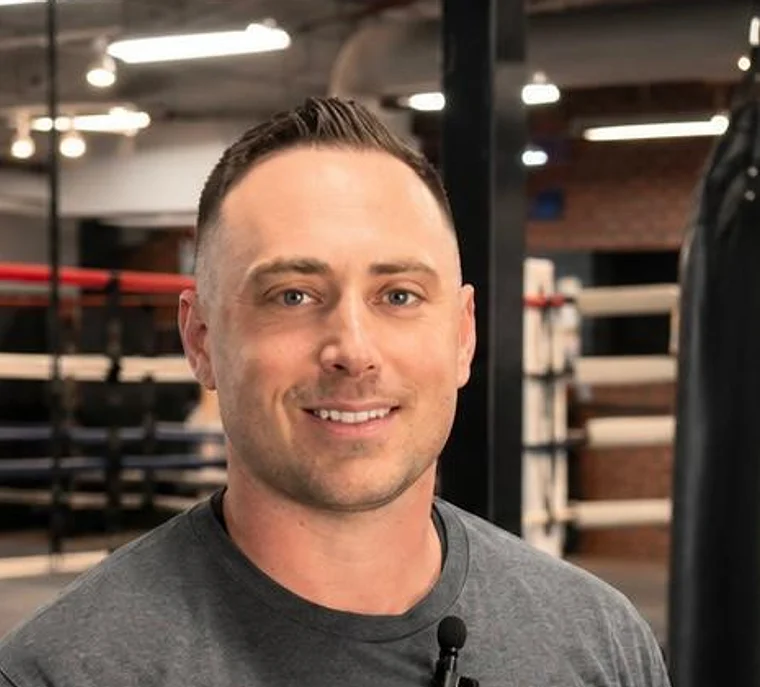
Coach Dean Moskowitz
Owner / Coach, Boxing for Balance — 500+ people with Parkinson's coached