
By Coach Dean Moskowitz
Fall Prevention Classes: What They Are and Where to Find One
Health information, not medical advice. Talk with your doctor before starting a new exercise program.
Quick answer: Fall prevention classes are structured programs — often free through senior centers, hospitals, and Area Agencies on Aging — that train the specific abilities that keep you upright: leg strength, balance reactions, walking confidence, and knowing how to get up if you do fall. Falls are worth taking seriously: the CDC reports about one in four adults 65 and older falls each year. Programs like Tai Chi for Arthritis and Fall Prevention, A Matter of Balance, and Stepping On are widely offered; call your local senior center or Area Agency on Aging (1-800-677-1116) to find one near you.
Nobody signs up for a fall prevention class because falling sounds interesting. People sign up because something happened — a stumble on the curb, a bad landing in the bathroom, a friend who fell and never quite came back to herself.
Here’s the part that deserves to be said louder: falling is not an inevitable part of aging, and the abilities that prevent falls can be trained at any age. I’ve watched people in their 80s and 90s measurably improve their steadiness in a matter of months. The body keeps its capacity to adapt much longer than our culture assumes.
What actually happens in a fall prevention class
Formats vary, but good programs cover the same territory:
Leg and hip strength. Sit-to-stands, step-ups, heel raises, squats to a chair. This is the foundation — when your legs can produce force quickly, a stumble stays a stumble instead of becoming a fall.
Balance training that gets progressively harder. Feet together, then tandem (heel-to-toe), then single-leg, then those same stances with head turns or eyes closed, always near a counter. Balance is a trainable skill and it improves with the same boring consistency as anything else.
Stepping and reaction drills. The most underrated part. Real falls happen when something unexpected shifts your weight, and recovery depends on getting a foot down fast in the right place. Classes drill quick steps in every direction, reaching outside your base, and stepping over obstacles.
Walking practice. Gait work, turning safely (wide, multi-step turns — not pivots), navigating thresholds and uneven ground, and dual-tasking: walking while carrying something or holding a conversation, since real-life falls rarely happen when you’re concentrating on walking.
Getting up from the floor. Practiced with a professional spotting. Nobody enjoys this drill; everybody should have it.
Home hazards and the “why.” Most programs include a home checklist (rugs, lighting, cords, grab bars) plus education on the sneaky contributors — medication side effects, blood pressure drops on standing, vision changes, unsafe footwear. Many also cover the fear of falling itself, which ironically raises fall risk by shrinking activity.
The evidence-based programs to look for
Several established programs are offered nationwide through senior centers, hospitals, YMCAs, and public health agencies, usually free or low-cost:
- A Matter of Balance — an eight-session program focused on both practical exercise and reducing the fear of falling.
- Tai Chi for Arthritis and Fall Prevention — gentle, flowing weight-shift practice; tai chi has one of the better track records in fall-prevention research.
- Stepping On — a multi-week workshop combining strength and balance exercise with home safety, vision, and medication review.
- Otago Exercise Program — typically delivered by physical therapists, a home-based strength and balance program for higher-risk adults.
- SilverSneakers and similar plan benefits — many Medicare Advantage plans include classes at participating gyms at no extra cost. Call the number on your insurance card and ask what fitness benefits you already have.
How to find one near you (free ones included)
- Your local senior center. The single best first call. Most run balance or fall prevention classes, and many are free.
- Area Agency on Aging via the Eldercare Locator: 1-800-677-1116. They know every program in your county.
- Your hospital’s community education department, especially if it has a rehab or geriatrics service.
- Your doctor or physical therapist. Ask directly: “Am I at risk for falls, and is there a class you’d recommend?” If your risk is meaningful, a PT referral may be the better route — physical therapy gives you an individualized program instead of a general class.
- The CDC’s STEADI resources, which many local providers build their programs around.
- For Parkinson’s specifically: the Parkinson’s Foundation Helpline at 1-800-4PD-INFO (1-800-473-4636) can point you to balance-focused programs designed for PD, where fall risk is higher and the causes are specific.
Why boxing is fall prevention in disguise
I’ll be honest about my angle here: I teach non-contact boxing to seniors and people with Parkinson’s, and my classes are — functionally — fall prevention classes that nobody calls that.
Watch what a boxing workout demands. Footwork trains quick, precise steps in every direction: that’s stepping-reaction training. Weight shifting with every punch is dynamic balance practice, hundreds of reps per class. Punching a pad builds the trunk and hip strength that catches you. Reacting to a moving target trains exactly the unplanned adjustments that real stumbles require. Combinations are dual-tasking — moving while thinking. And the whole thing is done standing, with support nearby, in a room where wobbling is normal and nobody’s embarrassed.
Then there’s the part no exercise physiologist can prescribe: confidence. Fear of falling makes people move less, which weakens them, which makes falls more likely. Hitting a heavy bag reverses that spiral in a way that “balance exercises” never quite manages. Members walk taller out of class than they walked in, and taller is steadier.
If you’d rather train balance while feeling like a fighter than while counting seconds on one leg, that’s not a lesser choice — it’s the same medicine in a package you’ll keep taking. My balance exercises guide has a starting set you can do at home today, and our classes are free for the first session at any of our four Los Angeles and Ventura County locations. Schedule here or call 747-234-1115.
What to do this week
- Call your senior center and ask what balance or fall prevention classes are on the schedule.
- Ask your doctor about your fall risk and get medications and vision reviewed — falls are often a medication problem in disguise.
- Do the ten-minute home walk-through: rugs down or gone, cords out of walkways, night lights in the hall and bathroom, grab bars where you brace yourself.
- Start something that trains standing balance three times a week — a class, a video, my home routine, or a room full of people in boxing gloves.
Falls are common. They are not inevitable. And nearly everything that prevents them is trainable, starting this week.
Dean Moskowitz is the head coach at Boxing for Balance. He has spent more than ten years helping over 500 people with Parkinson’s — and hundreds of older adults — build strength through non-contact boxing and exercise, in classes across Los Angeles and Ventura County. Talk with your doctor about your personal fall risk.
Sources: CDC — Facts about falls · CDC — Older adult fall prevention (STEADI) · Eldercare Locator (Administration for Community Living) · CDC physical activity guidance for older adults
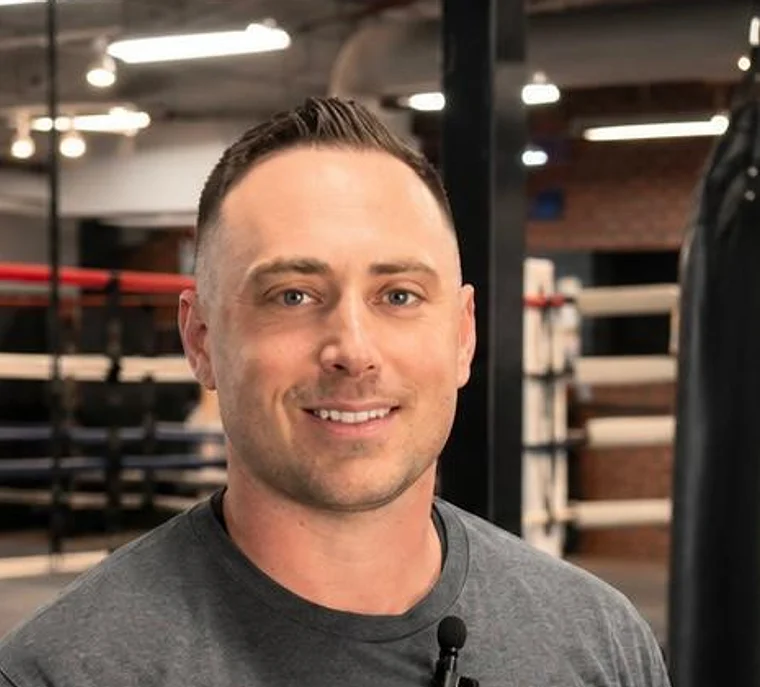
Coach Dean Moskowitz
Owner / Coach, Boxing for Balance — 500+ people with Parkinson's coached