
By Coach Dean Moskowitz
Cycling for Parkinson's: What the Research Shows
Health information, not medical advice. Talk with your doctor before starting a new exercise program.
Quick answer: Cycling is one of the most studied forms of exercise for Parkinson’s, largely because of research into “forced exercise” — pedaling at a faster cadence than a person would naturally choose, often on a tandem or motorized bike. Studies have reported improvements in motor symptoms with high-cadence cycling, and cycling is a genuinely good aerobic option for people with Parkinson’s because a stationary bike removes balance risk entirely. It works best as part of a program that also includes strength, balance, and amplitude training — cycling alone doesn’t cover everything Parkinson’s takes.
Every few months a member forwards me an article about the Parkinson’s cycling studies, usually with a note like “should I be doing this instead?”
Short answer: cycling is excellent, it’s well studied, and you should probably do some — but “instead” is the wrong frame, and I’ll explain why. Here’s what the research actually says, minus the hype that usually surrounds it.
The forced-exercise story
The interesting cycling research goes back to an observation on a tandem bike. Researchers noticed that when a person with Parkinson’s rode behind a stronger cyclist — who set a pace faster than the rider would choose alone — the rider’s symptoms improved more than they did with voluntary exercise at their own comfortable pace.
That idea became “forced exercise”: using a tandem or motor-assisted bike to hold cadence high (often around 80–90 revolutions per minute) while the person still works, just faster than self-selected. Subsequent studies, including work from the Cleveland Clinic group that pioneered it, have reported improvements in motor symptom scores with high-cadence cycling programs.
What researchers think is happening: the fast, rhythmic, repetitive pedaling may be driving activity in motor circuits in ways that self-paced exercise doesn’t — essentially using the bike as an external pacemaker, similar in spirit to how rhythmic music cues can smooth walking.
The honest caveats: these have generally been modest-sized studies, “forced exercise” is still an active research area rather than settled fact, and the studied programs are specific (supervised, high cadence, several times a week). No one has shown that cycling stops Parkinson’s from progressing. What’s reasonable to say is: cycling is well-supported as beneficial exercise for Parkinson’s, and higher cadence appears to matter more than casual pedaling.
Why cycling suits Parkinson’s so well
Beyond the research, cycling has practical virtues for this disease:
- No balance demand on a stationary bike. For someone with real fall risk, that’s a big deal — you can push hard aerobically without any risk of going down.
- Reciprocal, rhythmic movement. Pedaling is a steady, alternating pattern, and Parkinson’s brains respond well to external rhythm.
- Easy to measure and progress. Cadence, resistance, minutes — all trackable, which makes progression concrete.
- Symptom-friendly. Many people report that pedaling feels smoother than walking, and some notice tremor quieting during rides.
- It counts toward your 2.5 hours. The Parkinson’s Foundation recommends at least 2.5 hours of exercise weekly; cycling is an efficient way to bank a chunk of it. (See my exercise guidelines breakdown.)
How to actually do it
Choose your bike.
- Stationary upright or recumbent — the safest and most common choice. Recumbents are ideal if getting on and off is difficult or your posture is quite stooped.
- Motorized/assisted stationary bikes (the type used in forced-exercise programs) exist for home purchase but are expensive; some Parkinson’s centers, rehab clinics, and gyms have them. Ask around locally before buying.
- Tandem riding with a strong, sensible partner recreates the original research setup and is genuinely fun.
- Outdoor riding solo — only if your balance and reaction time are reliably good. Be honest with yourself, and talk to your PT. A three-wheeled trike is a smart middle path.
Structure a session. Five minutes easy warm-up. Twenty to thirty minutes of steady riding, aiming for a cadence that’s faster than feels natural — most bikes display RPM — while keeping resistance light enough to sustain it. Five minutes easy cool-down. Three times a week is a solid target.
Cadence over resistance. This is the one technique point I’d underline. The research interest is in fast pedaling, not heavy grinding. Light resistance, quick legs.
Safety basics. Ride during your medication “on” time. Have water. Have someone within earshot when you start. If you’re new to exercise or have heart concerns, get your doctor’s okay first — and if you can see a physical therapist to set up the bike and the program, do it.
Why cycling shouldn’t be your only exercise
Here’s the part the enthusiastic articles skip. Cycling is seated, straight-ahead, and repetitive — which is exactly why it’s safe, and also exactly why it can’t cover everything Parkinson’s takes from you:
- It doesn’t train balance. You can’t practice catching yourself while strapped to a chair with pedals.
- It doesn’t train stepping reactions — the fast, sideways, unplanned steps that prevent real falls.
- It doesn’t train amplitude. Cycling is a small, contained movement; Parkinson’s shrinks movement, and fighting that needs deliberately BIG reaching, stepping, and reaching-across work.
- It doesn’t do much for upper body strength, posture, or trunk rotation.
- It’s solitary. For a lot of people, that means it’s the first thing to quietly disappear from the schedule.
Which is why the best programs I see combine cycling with something that covers the rest. In my classes, footwork covers stepping reactions, punching covers amplitude and upper body, standing drills cover balance, and the group covers the motivation problem. Here’s what a class involves, and why boxing specifically helps Parkinson’s.
A great week might be: cycle Monday and Thursday, box Tuesday and Friday, walk on Saturday. Aerobic base from the bike, everything else from the class.
Where to start this week
If you have a stationary bike gathering laundry, dust it off and ride ten easy minutes today. If you don’t, check whether your gym, senior center, or Medicare plan’s fitness benefit gives you access to one — many do at no extra cost. And call the Parkinson’s Foundation Helpline at 1-800-4PD-INFO (1-800-473-4636) to ask whether there’s a Parkinson’s cycling program near you; they’re more common than most people realize, and often free or subsidized.
Then come round it out with the standing, stepping, punching parts. First class free at any of our four Los Angeles and Ventura County locations — schedule here or call 747-234-1115.
Dean Moskowitz is the head coach at Boxing for Balance. He has spent more than ten years helping over 500 people with Parkinson’s — and hundreds of older adults — build strength through non-contact boxing and exercise, in classes across Los Angeles and Ventura County.
Sources: Parkinson’s Foundation — Exercise · Parkinson’s Foundation — Exercise Recommendations · Dynamic high-cadence cycling improves motor symptoms in Parkinson’s disease (Front Neurol) · CDC physical activity guidance for older adults
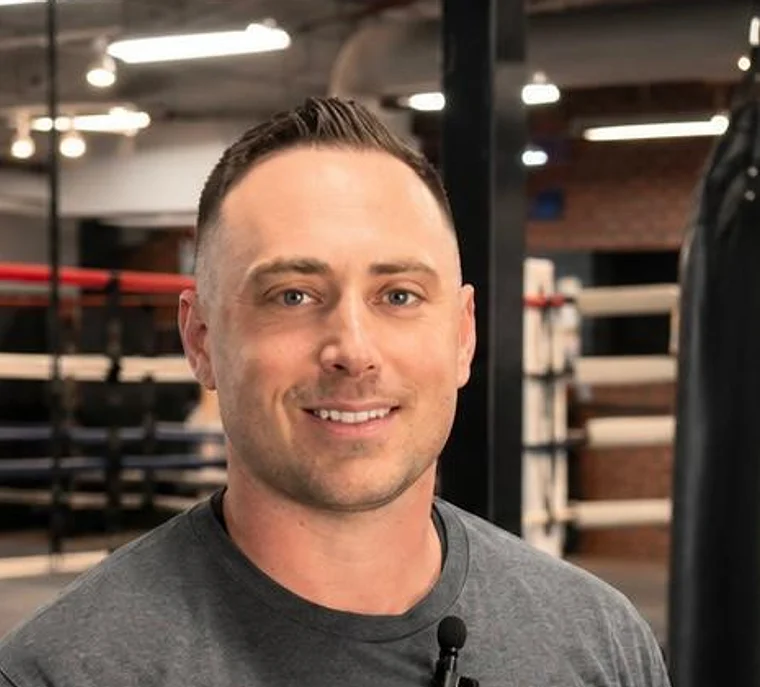
Coach Dean Moskowitz
Owner / Coach, Boxing for Balance — 500+ people with Parkinson's coached