
By Coach Dean Moskowitz
Seated Boxing Is a Real Workout — Here's the Proof
Health information, not medical advice. Talk with your doctor before starting a new exercise program.
Quick answer: Seated boxing is a genuine workout, not a watered-down one. You punch at full extension with real intent, train the core to hold you upright, and work strength and endurance — heart rates come up. A meta-analysis of chair-based exercise across 1,388 older adults found real gains in upper-body and lower-body strength, including the sit-to-stand strength that decides whether someone can get off a toilet unassisted. If standing for an hour isn’t available to you right now, this is not a consolation prize.
People assume the chair means the easy version. Then they do one round of seated punches with real intent and stop assuming that.
I’ve had members in their 60s who came in standing, watched a seated class, and asked to try it — and needed a towel afterward. I’ve had a man in a wheelchair out-punch his standing wife for an entire round while she laughed at him. The chair changes the base of support. It does not change how hard you’re allowed to work.
Here’s what a seated class actually involves, what the evidence says it does, and who it’s for.
What a seated class looks like
We warm up the shoulders, wrists, and neck — the joints that have to do the most work when your legs aren’t carrying you.
Then we punch. Big jabs, crosses, and hooks, at full extension, with real intent. This is the part people underestimate: a punch thrown properly from a chair recruits your shoulders, chest, back, arms, and — surprisingly to most people — your entire trunk, because something has to stop you from tipping over when your arm fires forward.
We work strength with light resistance, train the core to sit tall, and finish with stretching.
Heart rates come up. Sleeves get rolled. It counts.
Everything runs to music, and everyone counts out loud — which does double duty, because Parkinson’s quietly softens the voice and calling out punches is voice training smuggled into a workout.
What the research actually shows
A 2021 systematic review and meta-analysis in the International Journal of Environmental Research and Public Health pooled 25 studies covering 1,388 participants and looked at what chair-based exercise programs actually accomplish for older adults.
The results were meaningful:
- Handgrip strength improved.
- Upper-body strength improved, measured by the 30-second arm curl test.
- Lower-body function improved, measured by the 30-second chair stand — how many times someone can stand up from a chair in half a minute.
Sit with that last one. The 30-second chair stand isn’t a gym metric. It’s the same movement as getting off the toilet, out of the car, and up from bed. That measure is one of the better predictors of whether an older adult keeps living independently — and it improved from seated exercise.
The honest framing: this research is about chair-based exercise broadly, not boxing specifically, and the studies pooled were varied. But it directly contradicts the assumption that seated work is merely something to do until you can do real exercise.
Why it works at any age
I’ve coached seniors from 62 to over 100, and the chair is what makes the program fit everyone in the room.
The boxer next to you might be standing; you might be seated — you’re both doing the same combination, at your own pace. That matters more than it sounds. In most fitness settings, the person who needs a modification gets visibly separated from the group. In a boxing class, the combination is the combination. Everybody throws the same jab-cross. Some people are standing while they do it.
Seated work also removes the single biggest barrier for a lot of people: fear of falling. When falling is off the table, people work harder. I watch it happen — someone who’s tentative on their feet becomes genuinely aggressive once they’re anchored, and that aggression is where the training effect lives.
Who seated boxing is right for
People who can’t stand for long — or at all. Wheelchair users box in my classes. So do people who stand for part of the session and sit for the rest, which is extremely common and requires no announcement.
People recovering. After surgery, a fall, or a long illness, seated work rebuilds strength without asking your balance to do anything yet.
People in advanced Parkinson’s. Seated boxing is the version I teach most often in assisted living and memory care communities, where it reliably becomes the most popular thing on the activity calendar.
People who are simply afraid. Start seated. Plenty of my members did, and are standing now. Plenty aren’t, and are still boxing.
Anyone on a bad day. Parkinson’s is variable. Members who normally stand will grab a chair on an off day and nobody comments. The point is that you came.
How to make a seated workout harder
The most common mistake I see in seated training is treating it as a fixed ceiling. It isn’t. When a seated round stops being difficult, here’s the order I add difficulty — no standing required:
1. Extend fully, every rep. Before adding anything, take the range you already have. Most people are punching at about 70% extension without realising it. Going to full reach makes the same punch dramatically harder, and it’s amplitude training, which is the whole point.
2. Add tempo. Same punches, faster count. Aerobic demand climbs immediately.
3. Add duration before load. Go from 30-second rounds to 60, then 90. Endurance first, weight later.
4. Add a little weight. A one-pound dumbbell — or a can of soup — changes a punch combination completely. Do not jump to heavy; small weights at speed are plenty.
5. Add the cognitive layer. Longer combinations, called out in changing order. Now you’re dual-tasking, which is the thing Parkinson’s makes hard and therefore the thing most worth practising.
6. Sit unsupported. Move forward off the backrest so your trunk holds you up. This quietly turns every punch into core work.
Progress one of those at a time, not all six. And if a session leaves you unable to do the next one, that was too much — the goal is a workout you can repeat on Thursday.
Try it at home first
Want to feel what seated training is like before you visit? My chair exercises for seniors guide walks you through nine movements, step by step, and the free chair routine is a full 15-minute session you can do today with nothing but a sturdy chair.
A caution worth stating plainly: use a stable chair with armrests, no wheels, on a surface that won’t slide. Wear shoes, not socks. And if you have new pain, dizziness, or chest pressure, stop and talk to your doctor.
The part I most want you to hear
The chair is a piece of equipment, not a verdict.
I’ve watched too many people wait until they’re “ready” for exercise — meaning until they can do it standing, the way they remember — and lose months of strength in the waiting. Those months don’t come back easily.
If you or someone you love wants to try it, your first class is free, seated or standing. Bring the chair. Throw the punch properly. You’ll be surprised what that costs you.
Dean Moskowitz is the head coach at Boxing for Balance. A lifelong martial artist and former MMA fighter, he has spent more than ten years helping over 500 people with Parkinson’s — and hundreds of older adults — build strength through non-contact boxing and exercise, including weekly seated classes in assisted living and memory care communities across Los Angeles and Ventura County.
Sources: Chair-based exercise systematic review and meta-analysis (Int J Environ Res Public Health, 2021) · CDC physical activity guidance for older adults
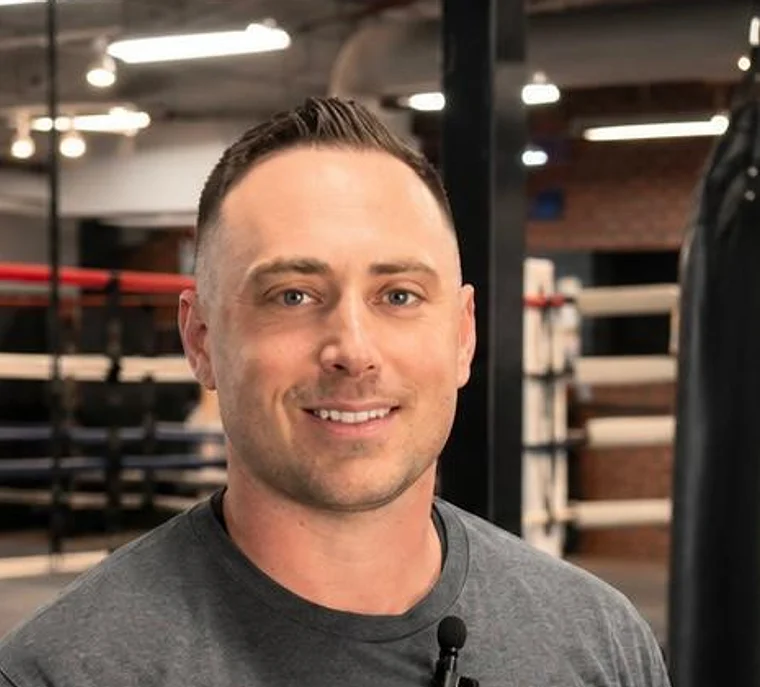
Coach Dean Moskowitz
Owner / Coach, Boxing for Balance — 500+ people with Parkinson's coached