
By Coach Dean Moskowitz
Newly Diagnosed With Parkinson's: Your First 90 Days
Health information, not medical advice. Talk with your doctor before starting a new exercise program.
Quick answer: In your first 90 days after a Parkinson’s diagnosis, four things matter most: get connected to a movement disorder specialist, start exercising now (the Parkinson’s Foundation recommends at least 2.5 hours a week, and starting early is associated with better outcomes), call the free Parkinson’s Foundation Helpline at 1-800-4PD-INFO (1-800-473-4636) for information you can trust, and find other people living with this. You do not have to overhaul your life this month. You do have to start moving.
I’ve met hundreds of people in the weeks after their diagnosis. There’s a look — I recognize it now from across the gym. Somebody’s spouse drove them here because a neurologist said “exercise,” and they don’t know what they’re walking into, and underneath that, they’re not sure who they are anymore.
So before anything practical: you’re going to be okay. Not because Parkinson’s is nothing — it’s not — but because this is a disease where what you do matters enormously, and you’re already doing the thing most people don’t do, which is looking for information instead of waiting.
Here’s what I’d tell you if you sat down across from me at the gym.
Week 1–2: Breathe, and don’t reorganize your life yet
Don’t read everything on the internet. Parkinson’s varies wildly from person to person; the worst-case stories you’ll find at 2 a.m. are not a forecast of your life. Stick to reliable sources — the Parkinson’s Foundation and your own care team.
Don’t make big decisions this month. Not about your job, your house, or your driving. Newly-diagnosed panic makes bad permanent choices. Give yourself time to learn what your Parkinson’s actually looks like.
Do call the Parkinson’s Foundation Helpline: 1-800-4PD-INFO (1-800-473-4636). Free, staffed weekdays in English and Spanish. Real people who will answer questions you’re embarrassed to ask and connect you to what’s near you. (The letters spell a phone-keypad shortcut for 1-800-473-4636.)
Do tell one or two people you trust. You don’t owe anyone else an announcement yet. But carrying this alone is heavier than it needs to be.
Week 2–4: Build the care team
A movement disorder specialist. This is the most consequential upgrade you can make: a neurologist with extra training specifically in Parkinson’s. Studies consistently find better outcomes for people under specialist care, and they know treatment nuances a general neurologist may not. Ask for a referral, or ask the Helpline to find one near you. Waits can be long — get on the list now, keep your current neurologist meanwhile.
A physical therapist, early. Not because you’re falling — because you’re not yet. A PT establishes a baseline, teaches amplitude and gait work, and gives you a home program. Ask your doctor for a referral to a PT with Parkinson’s experience, ideally LSVT BIG certified. Here’s what they do.
Ask about occupational and speech therapy too. OT protects daily tasks — handwriting, dressing, home safety. Speech therapy (particularly LSVT LOUD) protects the voice that Parkinson’s quietly shrinks. Both work better started early.
Someone for your head, not just your body. Depression and anxiety are common in Parkinson’s — genuine symptoms of the disease, not weakness. If your mood dropped after diagnosis, tell your doctor. This is treatable, and treating it makes everything else easier.
Week 2 onward: Start exercising (this is the big one)
If I could put one sentence in bold and have you remember only that: exercise is the closest thing we have to a disease-modifying treatment you control yourself, and starting early is associated with better outcomes.
The Parkinson’s Foundation recommends at least 2.5 hours (150 minutes) per week. Not eventually — now, while you feel relatively good and the habit is easiest to build. My full breakdown of how much, how hard, and what kinds is in Parkinson’s exercise: how much, how often, and what kind.
Your week should eventually include four things: aerobic work that gets you breathing hard, strength work twice weekly, balance practice, and big-amplitude movement that fights the shrinking Parkinson’s causes.
Where to start this week, in order of ease:
- Walk 20 minutes, three times. Biggest steps you can take, arms swinging. That’s it. That’s a start.
- Try a Parkinson’s-specific class. Boxing, dance, PWR!, cycling — how to evaluate one. Most offer a free trial, including ours.
- Add home work on off days with exercises at home or a free video.
Why I’m partial to boxing, briefly and honestly: it hits amplitude, balance reactions, strength, rhythm, and voice in one hour, and — more importantly — people keep coming. The research on boxing and Parkinson’s is encouraging rather than conclusive, but the adherence is the part I’ve watched change lives. The best exercise is the one you don’t quit.
Month 2–3: Find your people
Isolation does its own damage. Two doors in:
A support group. For the practical wisdom (which pharmacy, which neurologist, how to handle the work conversation) and for the relief of a room where nobody needs an explanation. My guide to LA-area support groups lists verified local options, and I host a free monthly online group — last Tuesday of every month, 2 p.m. Pacific, on Zoom, for people with Parkinson’s and care partners, no boxing required.
An exercise class. Sneakier and, for a lot of people, better. You come for the workout and leave with friends who understand. Half the community in my gym started as strangers with the same diagnosis.
Bring your care partner into both. Your spouse or adult child got a diagnosis that day too, in a different way. Caregiver’s Corner is written for them.
Practical things worth doing in the first 90 days
- Start a medication log. What you take, when, and how you feel. Patterns matter, and your neurologist will love you for it.
- Learn your “on” and “off” times once you’re on medication — schedule exercise and demanding tasks during “on.”
- Ask about exercise before medication questions get settled. They’re not in competition; do both.
- Handle the work conversation on your timeline. There’s no legal or medical requirement to disclose immediately. Learn your situation first.
- Do a quick home safety pass — rugs, cords, lighting, bathroom grab bars. Cheap, and it removes future problems. (Falls affect one in four adults 65+ each year; prevention starts before there’s a problem.)
- Keep doing what you love. Golf, choir, gardening, poker night. Parkinson’s takes what you surrender to it faster than what you defend.
What I’ve watched over ten years
The people who do best aren’t the ones with the mildest symptoms. They’re the ones who moved early and kept moving, who built a team instead of going it alone, and who stayed in their lives — still going to the thing, still seeing the people.
I’ve had members diagnosed in their 60s who are still boxing a decade later. I’ve had people start in their 80s, years in, and get measurably steadier. Late still works. Today still works.
Your first class with us is free, at any of our four locations across Los Angeles and Ventura County — schedule here or call or text 747-234-1115. Not local? The online program or the Foundation’s free virtual classes will get you started tonight.
Whatever you choose: start moving this week. Everything else can wait a little. That part can’t.
Dean Moskowitz is the head coach at Boxing for Balance. He has spent more than ten years helping over 500 people with Parkinson’s — and hundreds of older adults — build strength through non-contact boxing and exercise, in classes across Los Angeles and Ventura County. Talk with your doctor about your treatment plan and before starting a new exercise program.
Sources: Parkinson’s Foundation — Exercise Recommendations · Parkinson’s Foundation — Living with Parkinson’s · Parkinson’s Foundation Helpline · Parkinson’s Foundation — Exercise · CDC — Facts about falls
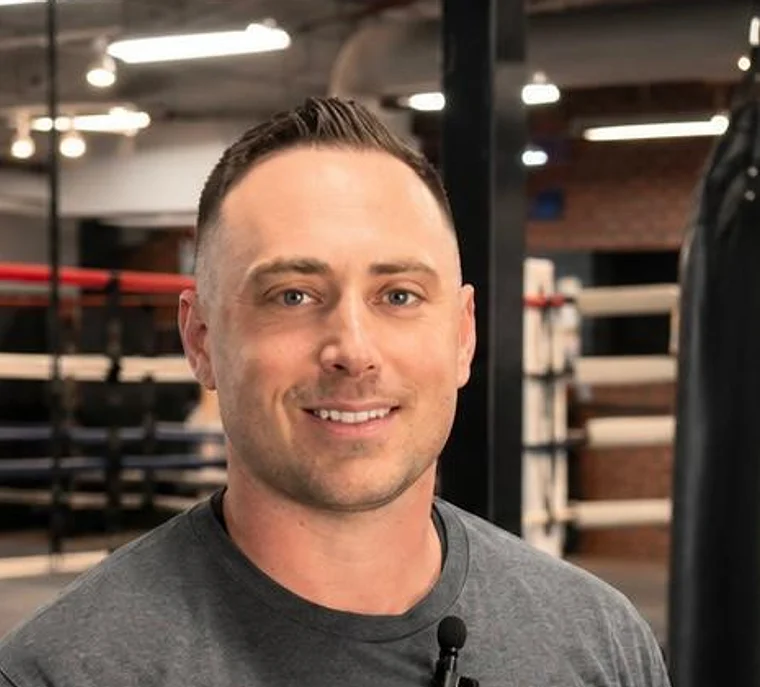
Coach Dean Moskowitz
Owner / Coach, Boxing for Balance — 500+ people with Parkinson's coached