
By Coach Dean Moskowitz
Physical Therapy Exercises for Parkinson's: What PTs Prescribe
Health information, not medical advice. Talk with your doctor before starting a new exercise program.
Quick answer: Physical therapy for Parkinson’s focuses on the problems the disease causes most: shrinking steps, stooped posture, stiffness, weak hips and legs, and unsteady balance. The exercises PTs prescribe — big amplitude movements, gait drills, sit-to-stands, step training, and trunk rotation — are ones you can and should practice between visits. Ask your neurologist for a referral to a PT who knows Parkinson’s; it’s typically covered by Medicare and most insurance when medically necessary.
Let me start with my usual disclaimer, because it matters: I’m a boxing coach, not a physical therapist. A PT evaluates your body and writes a plan for you; I lead group exercise and I’m careful to know the difference. But after ten years coaching more than 500 people with Parkinson’s, I’ve worked alongside a lot of great PTs, watched what they prescribe, and built my classes to reinforce it. Think of this article as a coach explaining the playbook so it makes sense — not replacing the person who writes it.
Why PTs are so valuable for Parkinson’s specifically
Parkinson’s has a signature. It shrinks movement (small steps, small reaches, small handwriting), stiffens muscles, rounds posture forward, and quietly erodes the automatic balance reactions that catch you when you trip. Physical therapists trained in Parkinson’s know this signature intimately, and their prescriptions attack it directly.
The Parkinson’s Foundation recommends at least 2.5 hours of exercise a week, and a PT is the ideal person to shape your portion of those hours — especially early after diagnosis, when good movement habits are easiest to build, and after any fall, freeze, or noticeable change.
The exercises PTs most often prescribe
Every plan is individual — that’s the point of PT — but these families of exercises show up again and again.
1. Amplitude training (moving BIG). The best-known version is LSVT BIG, a certified program built on one insight: Parkinson’s makes normal-sized movement feel big, so you must practice exaggerated movement until big feels normal again. The approach has encouraging research behind it — a small BMC Neurology study found LSVT BIG improved participants’ sense of their own movement, which may be part of how it works — though most studies in this area are modest in size. Typical drills: giant exaggerated steps, huge arm swings, big reaches across the body. I break the approach down in my LSVT BIG guide, and it’s baked into every class I teach — a punch thrown at full extension is amplitude training wearing boxing gloves.
2. Gait training (rebuilding your walk). PTs drill walking the way I drill footwork: deliberately. Long steps with heel striking first. Arm swing practice — sometimes exaggerated on the side that’s stopped swinging. Walking to a beat or metronome (rhythm powerfully unlocks Parkinson’s gait — more on that in my music therapy article). Turning practice with wide, multi-step turns instead of pivoting on one spot, because tight turns are where freezing and falls love to happen. If freezing of gait affects you, PTs teach specific cues to break the freeze — shifting weight side to side, stepping over an imaginary line, counting “one-two-THREE-go.”
3. Sit-to-stand and leg strengthening. The humble stand-up-from-a-chair is probably the most prescribed exercise in all of Parkinson’s PT, because thigh and hip strength decide independence — toilets, cars, beds, chairs. PTs program these in sets with careful form: scoot forward, feet back, lean nose-over-toes, push through the whole foot. Squats to a countertop, step-ups on a low step, bridges, and heel raises round out the usual strength menu. (My guide to strength training for seniors covers safe progressions for most of these.)
4. Balance and stepping reactions. Standing balance work — feet together, tandem stance, single-leg stands near support — plus the more dynamic drills that train your feet to react: quick steps in each direction, reaching far outside your base of support, weight shifts, and stepping over obstacles. This is exactly the territory where boxing shines, by the way: every drill in our classes is disguised balance-reaction training. My balance exercises guide has a safe starting set.
5. Posture and trunk rotation. Parkinson’s pulls you forward and locks the trunk. PTs counter with chest-opening stretches, wall angels (stand against a wall, slide arms up and down like a snow angel), shoulder blade squeezes, and rotation drills — reaching across the body, gentle twists. Stiff trunks steal balance and shrink breathing room; rotation gives both back.
6. Floor transfer practice. The exercise nobody wants and everybody needs: getting down to the floor and back up, practiced safely with a professional spotting you. If a fall happens, this skill is the difference between an inconvenience and hours on the floor waiting for help.
Between visits: how to actually do your home program
Every PT sends you home with exercises, and here’s the open secret of the profession: most people don’t do them. The therapy works exactly as well as the practice between sessions. What works for my members:
- Attach the routine to an anchor — after morning meds and breakfast is ideal, since you want to exercise during your “on” time anyway.
- Do it BIG, every rep. Amplitude work practiced small is practice at staying small.
- Count out loud. It keeps effort honest and (bonus) exercises your voice, which Parkinson’s also quiets.
- Put the printed exercise sheet somewhere shameless — taped to the fridge, not filed in a drawer.
- Bring your questions back. A good PT wants to hear “this one hurts my knee” or “I can’t feel this working.”
Getting a referral (and getting it covered)
Ask your neurologist: “I’d like a referral to a physical therapist with Parkinson’s experience.” Specifically ask about therapists certified in LSVT BIG or experienced with PD — the Parkinson’s Foundation Helpline at 1-800-4PD-INFO (1-800-473-4636) can help you find them, and the American Physical Therapy Association’s consumer site ChoosePT has a therapist directory. Medicare Part B generally covers outpatient physical therapy that a doctor certifies as medically necessary; most insurance behaves similarly, with the usual copays. Go early, re-visit after changes, and treat a PT “tune-up” every year or so as normal maintenance, not failure.
Where a coach fits in
A PT writes the prescription; a class is where the prescription becomes a lifestyle. Everything above — amplitude, gait, balance reactions, strength, rotation, rhythm — is woven into our non-contact boxing classes, which is why so many members land with us on their PT’s suggestion. The PT gets you moving right; we keep you moving, week after week, with people who get it.
First class is free at any of our four LA and Ventura County locations — schedule here or call 747-234-1115. And if you take one action from this article, make it the referral question at your next neurology appointment. One sentence, big payoff.
Dean Moskowitz is the head coach at Boxing for Balance. He has spent more than ten years helping over 500 people with Parkinson’s — and hundreds of older adults — build strength through non-contact boxing and exercise, in classes across Los Angeles and Ventura County. Always follow your physical therapist’s and doctor’s guidance.
Sources: Parkinson’s Foundation — Exercise Recommendations · LSVT-BIG and proprioceptive recalibration — BMC Neurology · ChoosePT — American Physical Therapy Association · Medicare.gov
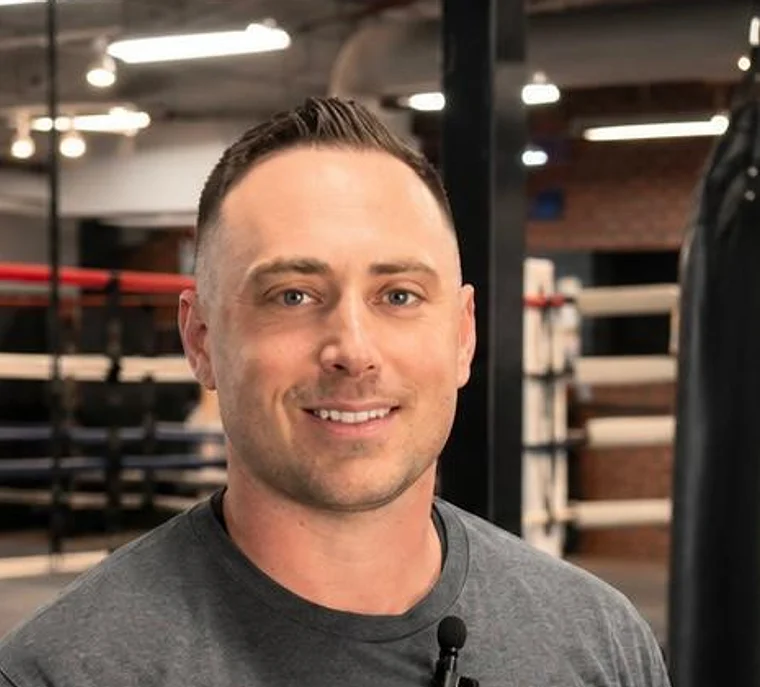
Coach Dean Moskowitz
Owner / Coach, Boxing for Balance — 500+ people with Parkinson's coached