
By Coach Dean Moskowitz
Parkinson's Exercise Videos: The Best Free and Paid Options
Health information, not medical advice. Talk with your doctor before starting a new exercise program.
Quick answer: The best free Parkinson’s exercise videos come from the Parkinson’s Foundation, which publishes workouts and hosts virtual classes at no cost, and from YouTube — where quality varies wildly, so choose channels led by credentialed instructors and videos matched to your level. Paid programs (like my own online program, $9.99 for the first month) earn their keep when you want fresh workouts on a schedule, a consistent coach, and programming built specifically for Parkinson’s. Whatever you choose, the right video is the one you’ll actually press play on three times a week.
Exercise videos changed everything for people with Parkinson’s who can’t get to a class — wrong city, no ride, immune concerns, or a Tuesday where leaving the house just isn’t happening. I coach people through a screen every week, including a whole community in Washington State that runs my video program with a coach I certified. Done right, video workouts are the real thing.
Done wrong, they’re a man on the internet doing burpees at people who need chair work. So let me be your guide — including honest advice about when not to pay for anything, from a guy who sells the paid thing.
Free option #1: The Parkinson’s Foundation (start here)
The Foundation publishes free exercise videos and runs free virtual movement classes — real workouts designed for Parkinson’s by people who understand it deeply. Their exercise pages are the front door, and their free Helpline at 1-800-4PD-INFO (1-800-473-4636) can point you to online and local classes, including many that cost nothing. If you watch only one set of videos from this article, make it theirs. (Full disclosure of my bias: the Foundation has featured my classes in their own videos — you can see one on our Parkinson’s boxing page — so I may be fond of them. I’m also right.)
Free option #2: YouTube (huge, free, uneven)
YouTube has thousands of Parkinson’s exercise videos, every one free. The catch is that nobody’s checking credentials at the door. How to pick well:
- Look for credentials in the channel’s about page — physical therapists, LSVT-certified instructors, and established Parkinson’s programs, not just enthusiastic strangers.
- Match the level honestly. Videos labeled “seated,” “beginner,” or “gentle” for starting out; save the advanced footwork for later. A too-hard video doesn’t make you fitter, it makes you quit.
- Favor Parkinson’s-specific over generic senior fitness when you can. PD-specific videos build in the things that matter: BIG amplitude movement, rhythm cues, balance support, voice activation. Generic is fine for extra volume once you have the basics.
- The three-video test. Try a channel three times. Were the instructions clear? Did your body feel worked but safe? Did you want to come back? Two out of three yeses is a keeper.
What makes an exercise video actually good for Parkinson’s
After a decade of making and watching these, here’s my checklist — use it on anything, including my own program:
- Seated and standing options shown together. Every body in the room accommodated, every exercise.
- BIG movement coached constantly. Amplitude is the heart of Parkinson’s exercise — the instructor should be nagging you to reach farther and step wider the entire time. (Here’s why that matters.)
- Rhythm you can lock onto. Music with a beat, counting out loud — rhythm is medicine for Parkinson’s movement, and a good video uses it on purpose.
- Voice involvement. Instructors who make you count, shout numbers, or say the punches out loud are sneaking in voice therapy. That’s a feature, not a quirk.
- Safety framing that respects you. Clear “have a chair nearby,” clear modifications, no pretending everyone’s the same — but also no treating you like you’re made of glass.
- A human you’d want in your living room three times a week. Not kidding. You’re choosing a recurring guest. Charisma counts, because consistency counts, and you won’t stay consistent with a bore.
When paid programs are worth it (and when they aren’t)
Stick with free if: you’re just starting and testing whether video workouts suit you; free content is keeping you consistent (if YouTube’s got you moving four days a week, don’t fix what isn’t broken); or budget is genuinely tight — free done consistently beats paid done never, every single time.
Paid starts earning its keep when you want: new workouts arriving on a schedule so you never rewatch yourself into boredom, one coach whose cues your body learns deeply, programming that progresses over months instead of random one-off videos, and the psychological nudge of a subscription — which, let’s be honest, gets some of us to press play.
Mine works like this, plainly: the Boxing for Balance online program is $9.99 for your first month, then $99 a month, cancel anytime, with two new Parkinson’s-focused workouts added every week — seated and standing options, boxing and strength and balance, all of it built on the checklist above. It’s featured on our site with samples so you can try before anything. And if a $0 Foundation class serves you better, I’ll cheer for you from here.
Making video workouts actually happen
The play button is the hard part. What works for my remote members:
- Schedule it like a class. Mon-Wed-Fri, 10 a.m., same spot. “I’ll do it sometime today” is where video workouts go to die.
- Set up a permanent corner. Chair, water, the device angled right, maybe light dumbbells. If setup takes five minutes, it’ll cost you two workouts a week.
- Cast to the biggest screen you have. Following form on a phone is squinting, not training.
- Exercise at your medication’s “on” time — same rule as any Parkinson’s exercise.
- Recruit a movement buddy. A spouse beside you, or a friend doing the same video in her own living room with a phone call after. Accountability survives the distance.
- Keep a fallback video. One short, easy, seated session for low days. The habit matters more than any single workout’s intensity.
The bottom line
Between the Parkinson’s Foundation’s free library, YouTube’s endless (if uneven) supply, and paid programs like mine, there has never been less excuse for geography to decide whether someone with Parkinson’s gets to exercise. Pick a source with the checklist, schedule it like it matters, and press play three times this week.
And if you’re ever within reach of Los Angeles or Ventura County, come feel the difference a live room makes — first class free, gloves provided: schedule here or call 747-234-1115.
Dean Moskowitz is the head coach at Boxing for Balance. He has spent more than ten years helping over 500 people with Parkinson’s — and hundreds of older adults — build strength through non-contact boxing and exercise, in classes across Los Angeles and Ventura County and online.
Sources: Parkinson’s Foundation — Exercise · Parkinson’s Foundation — Exercise Recommendations
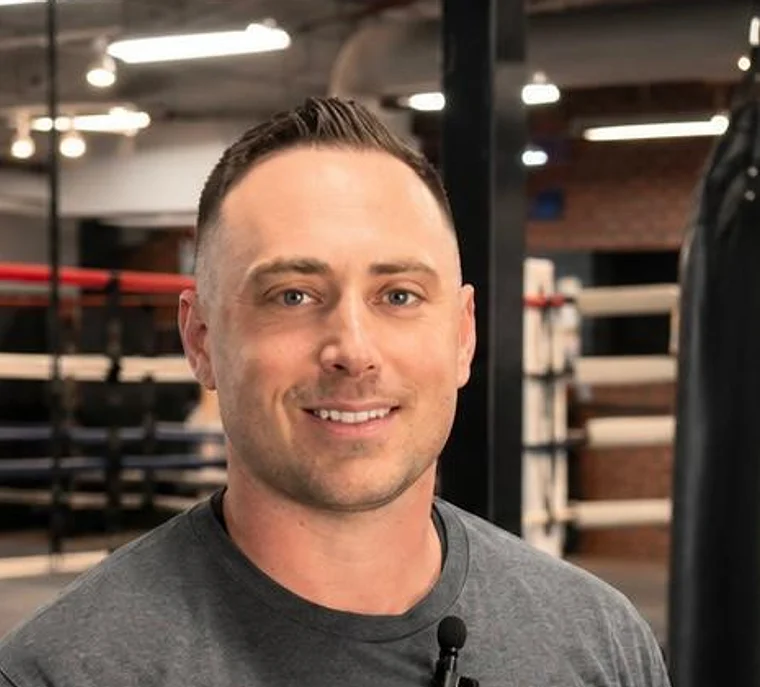
Coach Dean Moskowitz
Owner / Coach, Boxing for Balance — 500+ people with Parkinson's coached