
By Coach Dean Moskowitz
Is Rock Steady Boxing® Right for Every Stage of Parkinson's?
Health information, not medical advice. Talk with your doctor before starting a new exercise program.
Quick answer: Yes — with one honest asterisk. Rock Steady Boxing® is deliberately built to adapt across every stage of Parkinson’s: newly diagnosed members train hard and fast, later-stage members train seated or supported, and the curriculum scales every exercise in between — I’ve coached members who box from wheelchairs, and they train for real. The asterisk: adapted for is not the same as automatic for. Your doctor clears you first, a good coach assesses you individually, and on any given day the class bends to the body that shows up. If you’ve been told — or told yourself — that you’re “too far along” for boxing, that’s precisely the assumption this post exists to challenge.

Written by an official affiliate coach
Of all the reasons people give me for not trying a class, the stage-related ones are the most common and the most heartbreaking, because they come from both directions. The newly diagnosed person says, “I’m not bad enough yet — that’s for people who really have it.” The person ten years in says, “I’m past the point where that could help.” They can’t both be right, and in my experience coaching hundreds of people with Parkinson’s, they’re both wrong in the same way: they’re imagining a class built for someone else.
So let me walk through who’s actually in the room.
Newly diagnosed: the best time to start is now
If you’re in the first year or two after diagnosis, you are not “too early.” You’re at the single highest-leverage moment you’ll ever have. The Parkinson’s Foundation recommends at least 2.5 hours of exercise per week for people with PD, and establishing that habit while movement still comes easily is like saving for retirement in your twenties — everything compounds from there.
Newly diagnosed members in my classes typically train standing, fast, and hard. Many are barely distinguishable from a general fitness class — until you notice how deliberately we train balance, amplitude, and coordination, the abilities Parkinson’s erodes first. There’s a psychological piece too, and I don’t minimize it: walking into a room full of people living well with PD, some of them a decade or more in and still throwing combinations, rewrites the story your diagnosis just handed you. I’ve written about those first steps after diagnosis — a class like this belongs on that list.
Early-to-mid stage: the program’s center of gravity
Most of my members live here — managing symptoms, adjusting medications, noticing changes in balance, speed, or voice. This is where the curriculum shines brightest, because every element maps to a symptom:
- Balance and footwork drills target postural instability — the boxing stance and weight-shift work is fall-prevention training in disguise.
- Big, exaggerated punches fight the shrinking of movement, the same amplitude principle behind therapist-led programs like LSVT BIG.
- Loud counting trains the voice that Parkinson’s quiets — same use-it philosophy as dedicated speech programs.
- Dual-task drills — footwork while punching while counting — strengthen exactly the brain-body coordination the disease attacks.
The 2025 systematic review of boxing exercise for Parkinson’s found improvements in both motor and non-motor symptoms with strong safety and high adherence, and this population is where most of that research was done. It matches what I watch happen on the floor every week.
Later stage: seated, supported, and absolutely still boxing
Here’s the part too few people know. Every exercise in a good Rock Steady class has a seated version, and at my gyms the seated boxers aren’t parked in a corner doing a gentler imitation — they’re in the class, on the pads, in the count. Seated boxing is a real workout: rotation, punching power, coordination, cardio, and voice work all function from a chair or a wheelchair.
For later-stage members, the goals shift and sharpen: preserving the sit-to-stand, protecting the ability to catch yourself, keeping shoulders and trunk mobile, staying loud, staying connected. That last one is not soft-hearted filler. Isolation compounds everything hard about late-stage Parkinson’s, and a class where people know your name and notice your absence is protective in ways no home program replicates.
What changes at this stage is the importance of the intake conversation. Freezing episodes, orthostatic dizziness, swallowing changes, cognitive shifts — a good coach wants to know all of it, plans around it, and welcomes your care partner in the room (mine are; several have gloves).
The honest asterisk: when the answer is “not yet” or “not exactly this”
Adapted-for-everyone doesn’t mean assessment-free. The truthful boundaries:
Your doctor is the first gate. Unmanaged cardiac issues, recent falls with injury, severe orthostatic hypotension, or anything else your medical team flags — that conversation happens before your first class, not after. Nearly everyone gets a green light, often an enthusiastic one. But it’s not my green light to give.
Some days the answer is “modify,” and pride fights that. The member who insists on standing drills on a bad-balance day is my hardest coaching problem, not my proudest. The skill of scaling down without checking out is, honestly, one of the most advanced things we teach.
And boxing isn’t a monopoly. If the research points anywhere, it’s that consistent exercise of several kinds helps — boxing’s superpower is that people love it enough to keep coming. If another form of movement is the one you’ll stick with, a good coach cheers for that too.
How stages mix in one room — and why that’s the magic
People assume classes must be segregated by stage. Mine deliberately aren’t, beyond matching people to appropriate class intensities. The newly diagnosed member throwing fast combinations next to a wheelchair boxer isn’t awkward — it’s the whole point. One sees their possible future being fought for with dignity; the other sees their past self and feels seniority instead of loss. I’ve watched that exchange quietly change how both of them carry their diagnosis.
If you’re local, come see the room for yourself: my four licensed Rock Steady Boxing affiliate gyms are in Santa Monica, Lake Balboa, Woodland Hills, and Thousand Oaks, and your first class is free at any stage, seated or standing. (My online program, assisted living classes, and private training are Boxing for Balance — my own separate programs, not Rock Steady Boxing — and they exist precisely for the people a gym schedule doesn’t fit.)
Whatever stage you’re at: you’re not too early, and you’re not too late. You’re just not signed up yet — and the room, whichever version of it fits the body you have today, is already saving you a spot. Call or text 747-234-1115 and come claim it.
Clip-and-save summary: Rock Steady Boxing adapts to every stage of Parkinson’s — newly diagnosed members train fast and standing, later-stage members train seated or supported, and wheelchair boxers train for real. Requirements: your doctor’s clearance first, an honest intake conversation, and a willingness to modify on hard days. Nobody is too early. Almost nobody is too late. The four affiliate gyms I run — Santa Monica, Lake Balboa, Woodland Hills, Thousand Oaks — welcome every one of those stages, and the first class is free at all of them: 747-234-1115.
Sources
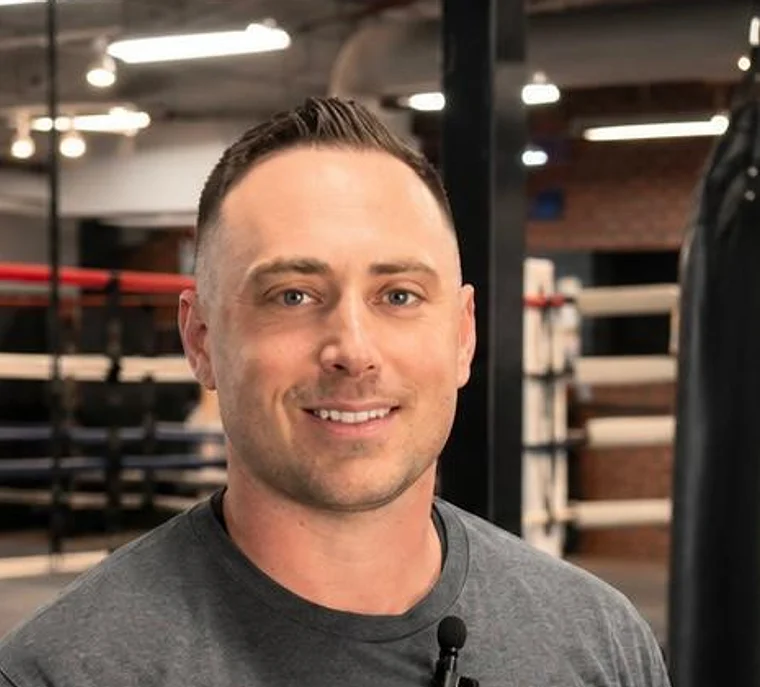
Coach Dean Moskowitz
Owner / Coach, Boxing for Balance — 500+ people with Parkinson's coached