
By Coach Dean Moskowitz
What Is Rock Steady Boxing®? A Coach Who Runs Four Affiliates Explains
Health information, not medical advice. Talk with your doctor before starting a new exercise program.
Quick answer: Rock Steady Boxing® is a non-contact, boxing-based fitness curriculum designed specifically for people with Parkinson’s disease. It was founded in 2006 in Indianapolis by Scott C. Newman, after his own Parkinson’s diagnosis at age 40, and has grown into a network of hundreds of affiliate gyms worldwide, overseen by the nonprofit Rock Steady Boxing, Inc. Nobody spars and nobody gets hit — classes adapt real boxing training (footwork, punching combinations on pads and bags, balance and coordination work) to target the exact abilities Parkinson’s attacks. I coach it every week: I operate four official Rock Steady Boxing affiliate programs across Los Angeles and Ventura County, so what follows is the view from inside the ropes.

Written by an official affiliate coach
People find their way to this question from every direction. A neurologist mentions it at an appointment. A friend’s husband swears by it. A YouTube video of grandmothers hitting focus mitts shows up in a feed. And then comes the search: what is Rock Steady Boxing, actually? Is it real boxing? Is it safe? Is it exercise or therapy or a support group?
Having taught it for years, my honest answer: it’s a little of all three, and that combination is precisely why it works.
Who started Rock Steady Boxing — and where it came from
The origin story matters, because it explains the program’s DNA. The founder of Rock Steady Boxing was Scott C. Newman — a former county prosecutor in Indianapolis — who was diagnosed with Parkinson’s at just 40 years old. As the organization tells its own story, Newman was determined to fight back and began training with his friend Vince Perez, a former Golden Gloves boxer — and something unexpected happened: the training helped his symptoms to the point where his tremor was controlled and he felt, in his word, rock steady. The two of them decided other people with Parkinson’s needed access to the same kind of training.
That was 2006. The first classes were six boxers in a borrowed exercise room in Indianapolis; adding professional boxer Kristy Rose Follmar as the first coach turned Newman’s discovery into a teachable curriculum, and from 2013 the organization began training coaches to carry the method to their own communities. Today the program is run by Rock Steady Boxing, Inc., a 501(c)(3) nonprofit (verifiable on GuideStar), and by its own count its classes are taught at over 800 licensed affiliate locations in every U.S. state and 14 countries — including the four I lead here in LA and Ventura County.
Notice what the program is not: it wasn’t invented by a fitness chain looking for a niche. It was built by a person with Parkinson’s, for people with Parkinson’s, around a discovery he made in his own body. Every good class still carries that spirit.
What actually happens in a class
Here’s a typical session at one of my affiliate gyms, minute by minute:
Warm-up and mobility. Every class starts by waking the body up — joint mobility, gentle range-of-motion work, getting blood moving. With Parkinson’s, cold-starting into hard exercise is asking for trouble, so we never do.
Balance, footwork, and coordination drills. Boxing stance work, weight shifts, stepping patterns, agility drills. This is where the “boxing” earns its keep: fighters train balance obsessively, and balance is exactly what Parkinson’s erodes.
Non-contact boxing. Combinations on focus mitts, heavy bags, and pads — jabs, crosses, hooks, thrown with intention and volume. We coach big, exaggerated movements on purpose, because Parkinson’s shrinks movement and we’re in the business of enlarging it. Counting punches out loud sneaks voice training in, too.
Strength and conditioning. Functional strength work — the getting-up-from-a-chair, carrying-the-groceries kind — plus cardio intervals scaled to each person.
Cool-down and stretching. And, in every class I’ve ever taught, more laughter than a stranger would predict.
Two rules govern everything: no contact, ever — nobody spars, nobody gets hit — and everything is modifiable. Every single exercise in the curriculum can be adapted, supported, or done seated. I’ve coached members who box from wheelchairs, and they train hard.
Does it actually work? The honest answer
I’m a coach, not a scientist, so let me point at the science rather than speak for it. A 2025 systematic review published in a peer-reviewed journal examined the research on boxing exercise for people with Parkinson’s and concluded that boxing training can improve both motor and non-motor symptoms, with good safety and notably high adherence — that last part meaning people actually stick with it, which in exercise research is half the battle. I’ve written a fuller, warts-and-all look at what the research says about boxing and Parkinson’s, including where the evidence is still developing.
The adherence finding matches what I see on the floor better than any other statistic. People don’t stay consistent with exercise they endure. They stay consistent with exercise they love — and there is something about wrapping your hands, hitting pads, and being part of a room full of people fighting the same opponent that keeps members showing up year after year. The Parkinson’s Foundation recommends at least 2.5 hours of exercise per week for people with PD; the members who hit that number most reliably, in my experience, are the ones who found a form of exercise that feels like theirs.
Who it’s for — and who it isn’t
Rock Steady Boxing is built for people with Parkinson’s at every stage — newly diagnosed members training alongside people who’ve lived with PD for fifteen years, standing boxers next to seated ones. No boxing experience is expected; almost nobody arrives with any. Care partners are welcome in my classes too, and plenty end up with gloves on.
Who is it not for? Anyone whose doctor hasn’t cleared them for exercise — that conversation comes first, always. And anyone looking for actual combat sport: this is boxing training, deliberately and permanently non-contact.
Rock Steady Boxing and Boxing for Balance — one coach, two names
Since you’re reading this on the Boxing for Balance site, let me make the relationship plain, because I never want anyone confused. The in-gym classes at my four affiliate locations — Santa Monica, Lake Balboa, Woodland Hills, and Thousand Oaks — are licensed Rock Steady Boxing affiliate programs, running the official curriculum.
Boxing for Balance is my own separate business: the online video program, assisted living classes, private training, and coach certification course are Boxing for Balance programs, not Rock Steady Boxing programs. Same coach, same philosophy of movement — but only the gym classes carry the Rock Steady name, and I keep that line bright on purpose.
How to try it
If you’re anywhere near Los Angeles or Ventura County, the path is short: find your nearest of the four gyms, or just schedule your first class — it’s free, gloves provided, zero commitment. If you’re elsewhere in the world, Rock Steady Boxing’s affiliate directory can point you to a licensed program near you — and if there isn’t one, my online program and free at-home routines can get you moving in the meantime.
Eighteen years ago a newly diagnosed prosecutor in Indianapolis refused to take Parkinson’s lying down, and because of that, this week a few hundred thousand people around the world will wrap their hands and throw punches at the disease. Come throw some with us.
Clip-and-save summary: Rock Steady Boxing = non-contact, boxing-based fitness for people with Parkinson’s. Founded 2006 in Indianapolis by Scott C. Newman after his diagnosis at 40; now a 501(c)(3)-run affiliate network spanning hundreds of gyms worldwide. Every exercise adaptable, seated or standing; research supports motor and non-motor benefits with high adherence. In LA and Ventura County, my four licensed affiliates are Santa Monica, Lake Balboa, Woodland Hills, and Thousand Oaks — and your first class at any of them is free: 747-234-1115.
Sources
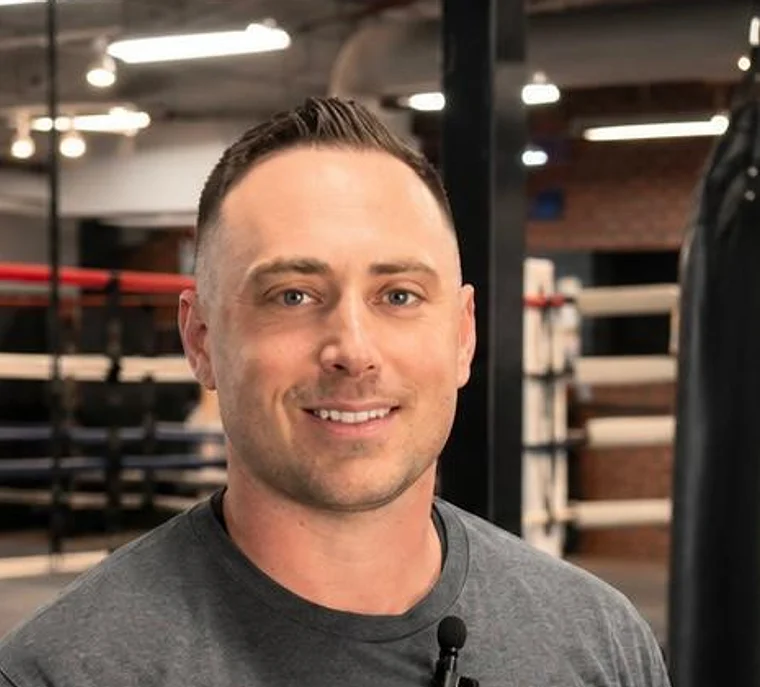
Coach Dean Moskowitz
Owner / Coach, Boxing for Balance — 500+ people with Parkinson's coached