
By Coach Dean Moskowitz
Is Boxing Good for Parkinson's? What the Research Says
Health information, not medical advice. Talk with your doctor before starting a new exercise program.
Quick answer: Yes, with an honest asterisk. Non-contact boxing gives people with Parkinson’s the exercise ingredients research supports most — aerobic effort, big movements, balance challenges, and multitasking — and a 2024 systematic review found significant improvements in balance and quality of life after boxing programs. Pooled results across all studies are more mixed, so boxing is best understood as one excellent way to get the vigorous, consistent exercise that clearly helps.
You may have heard about people with Parkinson’s putting on boxing gloves, and wondered whether that could possibly be a good idea. It is a fair question, and since I have spent ten years coaching exactly this, you deserve a straight answer — including the parts of the research that are still unsettled.
First, the essential clarification: nobody gets hit. Parkinson’s boxing is non-contact. You punch pads, bags, or the air. You never spar, and nothing ever punches back. What you keep from boxing is the training — the footwork, the reaching, the rhythm, the coordination — which happens to line up remarkably well with what Parkinson’s research says exercise should look like.
Why boxing, of all things?
Parkinson’s attacks specific abilities: balance, movement size, speed of reaction, and doing two things at once. Boxing training happens to drill every one of them:
- Weight shifting and footwork — constant, controlled balance practice
- Long, reaching punches — amplitude training, the same “move bigger” principle behind LSVT BIG therapy
- Combinations called out loud — multitasking for the brain and body together (“jab, jab, cross” is a memory task wearing gloves)
- Pad and bag rounds — genuinely aerobic effort, which the SPARX trial suggests matters for slowing motor symptom decline
- Reaction drills — a coach’s mitt moves, you respond, fast
The Parkinson’s Foundation and American College of Sports Medicine guidelines call for aerobic exercise, strength, balance/agility/multitask training, and stretching every week. A well-run boxing class delivers the first three in a single hour, which is a big part of why boxing programs for Parkinson’s have spread across the country.
What the studies actually show
Here is the evidence, without cherry-picking.
The encouraging results. A 2024 systematic review in the European Journal of Investigation in Health, Psychology and Education examined boxing training studies in Parkinson’s and found statistically significant improvements in balance and quality of life after boxing programs. Individual studies have also reported better mobility, gait, and disease-severity scores, and participants consistently report high enjoyment and attendance — people stick with boxing at rates many exercise programs would envy.
The mixed results. A December 2024 systematic review with meta-analysis in Revista de Neurología pooled 13 studies and found that boxing did not produce a statistically significant effect on functional mobility, balance, motor symptoms, gait, or cardiorespiratory fitness, with only a non-significant trend toward better quality of life — and the results stayed non-significant when boxing groups were compared directly against control groups. Its authors concluded the evidence “remains uncertain.” In plain English: when all the small studies are averaged together, boxing has not yet proven it beats other structured exercise.
And the reviews disagree with each other. A March 2025 systematic review in Frontiers in Aging Neuroscience looked at 13 studies covering 402 people with Parkinson’s and reached a more favorable conclusion — moderate-quality evidence that boxing is feasible and effective for lower-body strength, balance, mobility, gait, depression, and quality of life, with good safety and high adherence. Two reviews of similar size, published months apart, landing in different places is exactly what an unsettled evidence base looks like. That’s the honest state of it.
How to read that honestly. The studies so far are small, short, and varied in design — that is why reviews disagree. What no review disputes: exercise itself, done vigorously and consistently, is one of the best-supported things a person with Parkinson’s can do, and boxing is a safe, effective, unusually engaging way to get it. Boxing’s strongest scientific claim is not “magic punch therapy.” It is: this is high-quality exercise people with Parkinson’s actually keep doing. In a condition where consistency is everything, that is not a small claim.
What a class really looks like
If you pictured a grim fight gym, picture this instead: a room of people ages 50 to 90, some with walkers parked by the wall, gloves on, music up. A warm-up of big reaches and marching. Rounds on the pads with a coach calling combinations. Balance drills between rounds. Laughter — more than you would expect. Rest whenever you need it. Seated versions of everything for whoever wants them.
Every drill scales. In our classes, a person one year past diagnosis and a person fifteen years in train side by side, each at their own edge. That is not a special accommodation; it is how Parkinson’s boxing is designed.
And there is the part no study fully measures, though the quality-of-life findings hint at it: the room itself. Parkinson’s isolates people. A class full of others who understand — who notice when you are absent and cheer when your punch gets longer — fights that isolation twice a week, on schedule. Many of our members will tell you the people are half the medicine.
Who should try it — and who should be careful
Good candidates: almost anyone with Parkinson’s, at any stage, cleared by their doctor for moderate exercise. Earlier is better, per the exercise research, but our classes include people at every stage, standing and seated.
Talk to your doctor first if you have significant heart disease, uncontrolled blood pressure, severe freezing episodes, or frequent falls. Usually the answer is yes with modifications — but let a professional say so.
Skip the DIY heavy bag for now. Starting alone, unsupervised, with balance challenges and maximum effort is the one version of this we advise against. Start with a coached class built for Parkinson’s, learn your safe edges, then add home practice.
How to start
- Get your doctor’s okay for moderate-to-vigorous exercise.
- Find a Parkinson’s-specific class. Look for coaches trained in Parkinson’s exercise, seated options, and a first-class-free policy so you can feel the room before committing. Our classes run at four locations across Los Angeles and Ventura County — Santa Monica, Lake Balboa, Woodland Hills, and Thousand Oaks — and the first class is a free demo. See our locations.
- Commit to six sessions before judging. The first class is disorienting for everyone; the sixth is where most people find their rhythm. Give the experiment a fair run.
- Add home practice between classes. Shadow boxing to music, ten minutes, most days. It keeps the week’s total up where the research says it matters — our online program makes it push-play simple.
Frequently asked questions
Will boxing slow my Parkinson’s progression? Nobody can promise that, and you should be wary of anyone who does. What research supports: vigorous, consistent exercise is associated with slower decline in motor symptoms and quality of life, and boxing is a proven way to exercise vigorously and consistently.
Am I too old to start? Too far along? Our oldest members are in their 90s, and classes include people many years past diagnosis. Movements scale to every stage, including fully seated. The honest answer is: come try a class and see for yourself.
Do I need boxing experience? None. Most of our members had never thrown a punch before their first class. The skills take exactly as long to learn as you have.
Is it safe for someone with balance problems? In a Parkinson’s-specific class, yes — that is the point. Support is nearby, drills are modified, and coaches are trained for it. Balance problems are a reason to come, not a reason to stay away.
Dean Moskowitz is the head coach at Boxing for Balance. A lifelong martial artist and former MMA fighter, he has coached over 500 people with Parkinson’s during the past decade across Los Angeles and Ventura County.
Sources: Boxing, balance and quality of life in Parkinson’s — systematic review (EJIHPE, 2024) · Efficacy of boxing training in Parkinson’s — systematic review and meta-analysis (Rev Neurol, Dec 2024) · Effects of boxing exercise in people with Parkinson’s — systematic review (Front Aging Neurosci, 2025) · Parkinson’s Foundation exercise recommendations
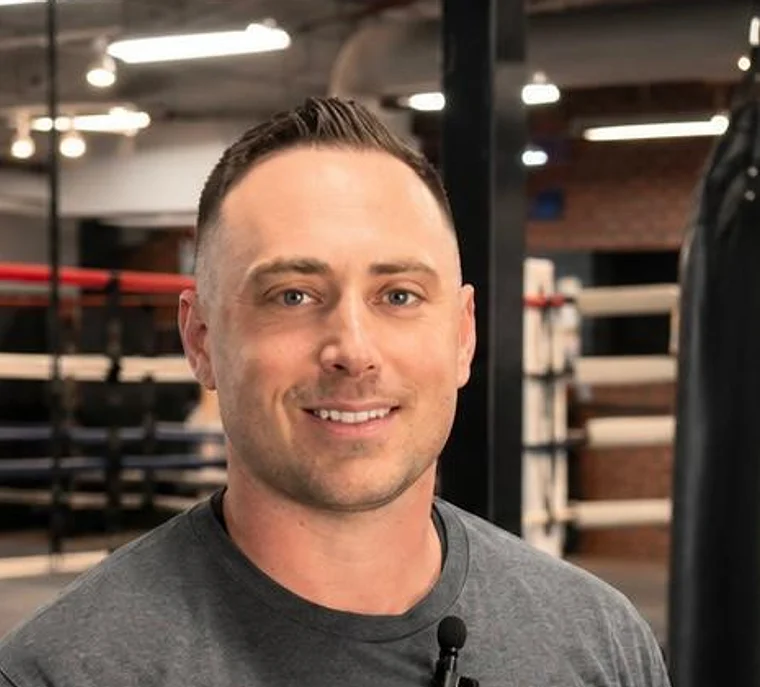
Coach Dean Moskowitz
Owner / Coach, Boxing for Balance — 500+ people with Parkinson's coached