
By Coach Dean Moskowitz
Senior Exercise Classes: How to Pick the Right One for You
Health information, not medical advice. Talk with your doctor before starting a new exercise program.
Quick answer: The best senior exercise class is the one you’ll still be attending in six months — but some types do more for specific goals. For balance and fall prevention: tai chi, boxing, or a dedicated balance class. For strength: resistance or “strength for seniors” classes. For joints and pain: water aerobics. For Parkinson’s specifically: non-contact boxing or PD-focused exercise classes. Free and low-cost options are widely available through senior centers, Medicare Advantage fitness benefits, libraries, and hospital community programs — call your senior center or the Eldercare Locator at 1-800-677-1116 to find them.
There’s a moment I see all the time: someone finally decides to start exercising, opens a class schedule, and finds twenty options with names like “Gentle Flow,” “Silver Circuit,” and “Aqua Fit” — and closes the schedule, overwhelmed, deciding to figure it out later.
Later has a way of becoming never. So let me demystify the menu. Here’s what each type of class actually does, who it fits, and how to find one without spending money you don’t need to spend.
What each type of class actually does
Tai chi. Slow, flowing weight shifts. Excellent for balance — it has one of the better track records in fall-prevention research — plus it’s gentle on joints and calming. Downside: not much for building real strength or cardiovascular fitness. Best for: balance, fall risk, arthritis, anyone who finds fast movement overwhelming.
Strength or resistance classes. Bands, light dumbbells, body weight. This is the type that most directly protects independence, because muscle is what gets you off the toilet and up the stairs. Every adult over 65 should be doing some version twice a week. Best for: everyone, honestly. Especially anyone who’s noticed getting up from chairs is harder than it was. (My strength training guide covers what these classes teach.)
Water aerobics / aqua fit. The water carries your weight, so painful joints get a break while you still work hard. Great cardio, very low fall risk. Downside: because water supports you, it doesn’t train the bone loading or standing balance you get on land. Best for: arthritis, hip and knee pain, recovery from surgery, significant obesity.
Chair or seated fitness. Real work, no fall risk — the research is solid, with one review across 1,388 older adults finding chair exercise improved arm and leg strength. Best for: frailty, recovery, very deconditioned starters, anyone who can’t stand for long. See my chair exercises guide.
Yoga (gentle/chair yoga). Flexibility, breathing, some balance and mind-body calm. Look for classes labeled gentle, chair, or restorative. Best for: stiffness, stress, sleep, posture.
Walking groups. Free, social, sustainable, real cardiovascular benefit. Doesn’t build strength or balance on its own. Best for: pairing with a strength or balance class.
Dance (line dancing, ballroom, Zumba Gold). Cardio, balance, coordination, memory, and fun in one package — plus rhythm, which is genuinely therapeutic for aging brains. Best for: people who’d rather do anything than “exercise.”
Non-contact boxing. My bias is obvious but the reasoning is honest: boxing combines footwork (stepping reactions), punching (upper body strength and amplitude), constant weight shifting (dynamic balance), and combinations (cognitive dual-tasking) in one class. It’s the most complete package I know for older adults, and it’s the standard of care conversation for Parkinson’s — see why it helps and what a first class looks like. Best for: Parkinson’s, balance and fall concerns, and anyone bored senseless by conventional classes.
Parkinson’s-specific classes. If you have PD, prefer a class built for it. They train amplitude, rhythm, voice, and balance in ways generic senior fitness doesn’t. The Parkinson’s Foundation Helpline (1-800-4PD-INFO / 1-800-473-4636) will help you find them anywhere in the country.
Matching class to goal
- “I’m afraid of falling.” → Tai chi, balance class, or boxing. Add strength work. See fall prevention classes.
- “Getting off the couch is getting harder.” → Strength class, twice a week, no substitutions.
- “Everything hurts.” → Water aerobics or gentle yoga, then add strength as pain allows.
- “I have Parkinson’s.” → PD-specific class or non-contact boxing, at least twice weekly.
- “I’m lonely.” → Any group class with a social culture. Walking groups and dance are especially good for this, and honestly, the friendship is the health benefit — social connection shows up in longevity research as powerfully as exercise does.
- “I get bored and quit.” → Dance or boxing. Novelty is a legitimate selection criterion.
How to find classes (including free ones)
- Senior centers — the first call to make. Often free, and the social side is unmatched.
- Your Medicare Advantage fitness benefit. Many plans include gym and class access (SilverSneakers is the best-known). Call the number on your insurance card and ask, “Do I have a fitness benefit?” A surprising number of people are entitled to free classes and never knew.
- Eldercare Locator: 1-800-677-1116 — connects you to your Area Agency on Aging, which knows every local program.
- Hospital community education programs, YMCAs, parks and recreation departments, and libraries.
- Faith communities — many host exercise groups.
- Physical therapy first, if you’re fragile or post-fall. A PT can get you ready for a class safely; insurance often covers it when medically necessary.
Questions to ask before you join
- “Can I try one class free?” Most reputable programs say yes. (Ours always does.)
- “What’s the age and ability range?” You want to be neither the frailest nor the fittest by a mile.
- “Are exercises modified for different levels — can I sit if I need to?” The answer must be an immediate, comfortable yes.
- “What’s the instructor’s background with older adults?” Certifications matter; experience with bodies like yours matters more.
- “How many people are in a class?” Smaller means more eyes on your form.
- “What if I need to stop and rest?” Listen for the tone, not just the words.
The one thing that matters more than the type
Six months from now, the class that helped you is the one you kept attending. Not the theoretically optimal one — the one with the people you like, at a time you can make, taught by someone whose voice you don’t mind hearing.
So take the free trial. Take three free trials. Pick the room where you laughed. If that room happens to be full of seniors in boxing gloves in Los Angeles or Ventura County, your first class with us is free — or call 747-234-1115 and I’ll tell you which of our four locations fits your schedule. If it’s the tai chi class at the senior center instead, I’ll count that as a win too.
Just pick one this week. That’s the whole assignment.
Dean Moskowitz is the head coach at Boxing for Balance. He has spent more than ten years helping over 500 people with Parkinson’s — and hundreds of older adults — build strength through non-contact boxing and exercise, in classes across Los Angeles and Ventura County.
Sources: CDC physical activity guidance for older adults · CDC — Facts about falls · Chair-based exercise systematic review (Int J Environ Res Public Health, 2021) · Eldercare Locator · Parkinson’s Foundation — Exercise
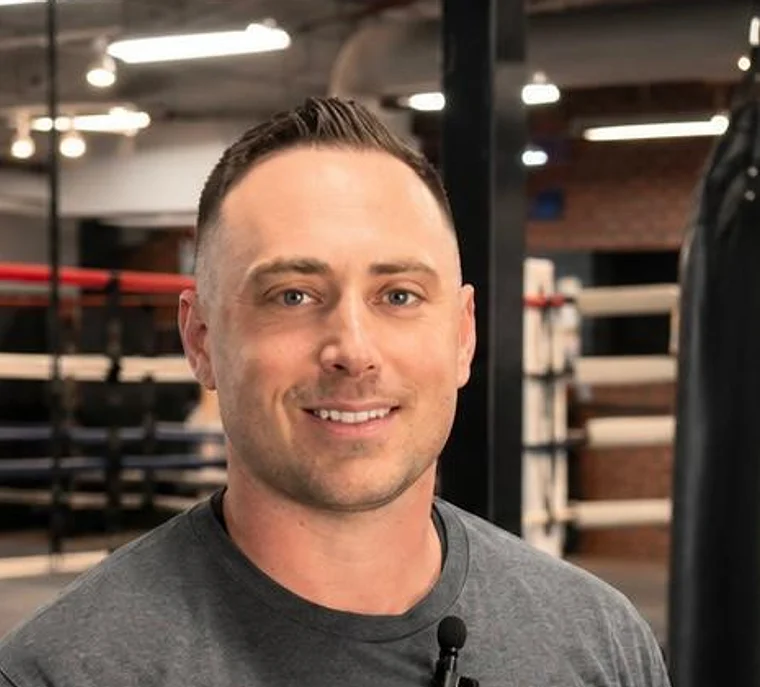
Coach Dean Moskowitz
Owner / Coach, Boxing for Balance — 500+ people with Parkinson's coached