
By Coach Dean Moskowitz
Acceptance Isn't Giving Up — Parkinson's & Mental Health
Health information, not medical advice. Talk with your doctor before starting a new exercise program.
Acceptance isn’t giving up. It’s giving up the fight with reality so you can put your energy back into living.
I heard something in my Parkinson’s support group recently that stayed with me. One of the men was talking about how he used to constantly check himself. Was that tremor worse? Did that movement feel different? Why did I feel that today? What does this symptom mean?
He said that eventually he got to a place where he simply accepted that he had Parkinson’s and started taking things one day at a time.
The way he described it was so simple. And there was something powerful about it, because mental health is the part of living with Parkinson’s that nobody hands you a prescription for. He wasn’t saying Parkinson’s was easy. He wasn’t saying he liked having it, and he certainly hadn’t stopped taking care of himself. He was saying something different: he had stopped fighting the fact that this was his reality. And when he stopped spending so much energy trying to make reality different, he had more energy available for his actual life.
That distinction matters more than almost anything else I talk about with my boxers. Accepting a Parkinson’s diagnosis gets misunderstood as surrender — “well, this is my life now, so I guess there’s nothing I can do.” I don’t think that’s what acceptance means at all. I think acceptance can be one of the most active things we do. It’s the moment we stop wasting energy fighting something that has already happened and start deciding what to do with the energy we have today.
You don’t have to like something to accept it
Let’s start simple: acceptance doesn’t mean you like something. You can accept that it’s raining while still wishing you could have gone to the beach. You can accept that your body has changed while still working to improve your strength, balance, and confidence. And you can accept a Parkinson’s diagnosis while still doing everything within your control to live as fully as possible.
Those things aren’t contradictory. Acceptance actually makes the effort more meaningful. There’s a big difference between “I exercise because I’m terrified of what happens if I don’t” and “I exercise because I want to take care of myself and enjoy what my body can do.” From the outside, those two people might be doing the exact same workout. Inside, they’re having completely different experiences. One is running from something. The other is moving toward something.
The rocks we carry
Here’s how I think about it. Imagine you’re wearing a backpack, and every day you put a few rocks into it.
Some of those rocks are unavoidable. Parkinson’s itself is a rock. An appointment is a rock. A difficult symptom is a rock. Those are real, and you genuinely have to carry them.
But then we start adding more. What if this gets worse? Another rock. Was that movement different than yesterday? Another. What if I can’t do this in five years? Why can’t my body go back to the way it was? Another and another. Pretty soon we’re walking around with a backpack full of rocks, and we’re exhausted.
Acceptance doesn’t remove the original rock. It doesn’t erase Parkinson’s, and it doesn’t mean you stop exercising, stop going to appointments, or stop taking care of yourself. Acceptance means you stop putting unnecessary rocks in the backpack. You don’t have to carry every what-if. You don’t have to check every sensation. You don’t have to solve tomorrow today.
Take even a few rocks out and you can walk a little easier. You can pay attention to the person sitting across from you. You can enjoy dinner. You can laugh. You can live. That’s what acceptance gives you — not a different reality. A lighter backpack.
When checking yourself takes over
Anyone living with Parkinson’s knows how tempting it is to monitor yourself. You notice something, so you check it. You compare it to yesterday. You wonder whether it changed. And because you’re paying closer attention, you notice more — which gives you more to check.
Pretty soon your attention is constantly being pulled back toward your body. You’re at dinner with your family, but part of your mind is checking. You’re walking outside, but instead of enjoying the walk, you’re evaluating your walking.
It’s understandable. When we’re afraid of losing something, we watch it closely. But there’s a difference between being aware of your body and being consumed by it — between taking care of yourself and constantly checking yourself. Sometimes the most freeing thing we can say is: I don’t need to check this right now. Not because we don’t care. Because we care about our life, too.
What boxing taught me about reality
I’ve spent my whole life around boxing, and one of the first things you learn is that you can’t control everything that happens in a fight. You can’t control every punch. You can’t control how your opponent moves, or whether you get tired, or what happened in the last round.
But you can control how you respond. Your breathing. Your feet. Your attention. What you do with the next moment.
That’s one of the reasons I love this sport. It teaches you to come back to what is actually happening — not what you wish were happening, not what happened five minutes ago, not what might happen five minutes from now. Where are my feet? Where is my breath? What’s the next move?
Life doesn’t always give us the circumstances we would choose. But we still get to choose what we do with the moment in front of us.
Acceptance doesn’t mean stopping
This matters especially with Parkinson’s: acceptance should never be confused with giving up on movement. Exercise still gives you a physical challenge, a routine, confidence, and connection — that’s exactly why I believe so strongly in boxing for Parkinson’s.
But the reason you move matters. You don’t have to move because you’re terrified of your diagnosis. You can move because you want to feel strong. Because you enjoy being around people. Because music makes you smile. Because you want to keep doing the things you love, and you want to see what you’re capable of today.
You’re not exercising against Parkinson’s. You’re exercising for your life.
If you’re looking for a supportive way to stay active, come see our Parkinson’s boxing classes and find out whether Boxing for Balance is a good fit for you.
You are more than your diagnosis
A diagnosis can become a very big part of someone’s identity. You hear the word from doctors, you read about it, you join groups, and suddenly it can feel like every conversation leads back to Parkinson’s.
But you’re still you. A husband or wife. A grandparent. A friend. Someone who loves the beach, makes terrible jokes, laughs too loud, still has dreams. Parkinson’s may be part of your story — it doesn’t have to be the entire story.
Acceptance helps create that separation. Yes, this is something I’m living with. And also: this is not all that I am.
Come for the exercise, leave with friends
One of the things I’ve always loved about our classes is that the benefit isn’t limited to what happens when the gloves go on. Yes, we punch. We work on coordination and balance and footwork. We laugh. We sweat.
But something else happens: people connect.
I’ve watched people walk into a boxing class feeling like their world had gotten smaller — activities given up, friends who don’t quite know what to say, a lot of time spent thinking about what’s been lost. Then they walk into a room where everyone is moving, nobody needs a long explanation, and nobody has to pretend everything is perfect. Everybody is there for the same basic reason: we’re here, let’s move.
I’ve always believed community is part of the medicine — not medicine in the literal sense, but in the sense that human beings need connection, belonging, laughter, and purpose. That’s why one of my favorite ideas for Boxing for Balance is: come for the exercise, leave with friends. The exercise gets you through the door. The community keeps you coming back.
And you don’t have to go through any of it alone. There’s something different about talking with people who don’t need you to explain every little thing — who understand the uncertainty, the awkward moments, the good days and the frustrating ones. Sometimes the most helpful thing isn’t advice. It’s realizing I’m not the only one. If you’re looking for that kind of connection beyond class, here’s my guide to Parkinson’s support groups in Los Angeles.
The future is not happening today
This may be the hardest part. Our brains love to jump ahead. What if this gets worse? What will I be able to do in five years? What happens when I’m older?
Those questions feel urgent. But you don’t have to live tomorrow today. Worrying about every possible future doesn’t give you more control over that future — it just takes energy from today. That’s another rock for the backpack, and you don’t need to carry it yet.
There’s a beautiful simplicity in asking instead: what is true today? Maybe today you can walk. Maybe today you can box. Maybe today you can hug your grandkids, or laugh until your stomach hurts. Maybe today is hard. Whatever today is, that’s the day you have. And that’s enough.
What are you fighting that you don’t need to fight?
This question is worth asking — and not just for people with Parkinson’s.
Maybe you’re fighting your diagnosis. Maybe you’re fighting getting older, or the fact that your body isn’t what it used to be, or something that happened years ago, or the simple truth that you can’t control everything.
And maybe the question isn’t how do I win this fight? Maybe it’s do I need to be in this fight at all?
Sometimes the most courageous thing isn’t throwing another punch. Sometimes it’s lowering your fists, taking a breath, taking a few rocks out of the backpack, looking around — and realizing: I want to be here.
So instead of “why is this happening to me?” — try “okay, this is where I am. What can I do today?” Instead of “I used to be able to do this” — “what can I do now?” Instead of “what if I lose this?” — “how can I enjoy it while I have it?” Those questions put you back in the driver’s seat.
None of this means giving up on goals, by the way. You can still want to get stronger, improve your balance, travel, dance, play with your grandchildren. The difference is that a goal stops being a referendum on your worth. Great workout? Celebrate it. Hard day? You’re still you. Come back tomorrow. That’s resilience — not pretending everything is perfect, just continuing to participate in your own life.
Give yourself permission to live
If you’re living with Parkinson’s, or caring for someone who is, I hope you remember this: you are allowed to live. Not just manage. Not just monitor. Not just research and prepare and worry. Live.
Go to dinner. Call a friend. Take the trip. Go to the grandkid’s soccer game. Dance badly. Sit in the sunshine. Have a conversation that has absolutely nothing to do with Parkinson’s. And if you’re having a hard day, that’s okay too — you don’t have to turn every day into a victory. Some days are simply days.
The man in my support group didn’t make acceptance sound complicated. He didn’t have an elaborate formula. He stopped checking everything and started taking life one day at a time. It reminded me that we often make life harder by trying desperately to control what can’t be controlled. We want certainty. We want guarantees. Life doesn’t give us that.
What it gives us is today. This moment. This breath. This person next to us. This round.
And maybe we don’t need to win every round. Maybe we just need to stay in the ring. Stay present. Keep moving. Keep connecting. Keep laughing. Keep living.
Because acceptance isn’t giving up. It’s giving up the fight with reality so you can put your energy back into living — taking a few rocks out of the backpack, letting go of the what-ifs you don’t have to carry, and letting Parkinson’s be part of your life without becoming your entire life.
So put the gloves down for a moment. Take a breath. Look around. You’re here.
Now let’s live.
Ready to keep moving?
If you’re looking for Parkinson’s exercise and a community of people who understand, we’d love to have you. Try a Boxing for Balance class — your first one is free. Or if you’re looking for connection and conversation beyond exercise, start with my guide to local Parkinson’s support groups.
You don’t have to have everything figured out. You don’t have to know what the future holds. You just have to show up for today.
Come for the exercise. Leave with friends. Keep moving. Keep connecting. Keep living.
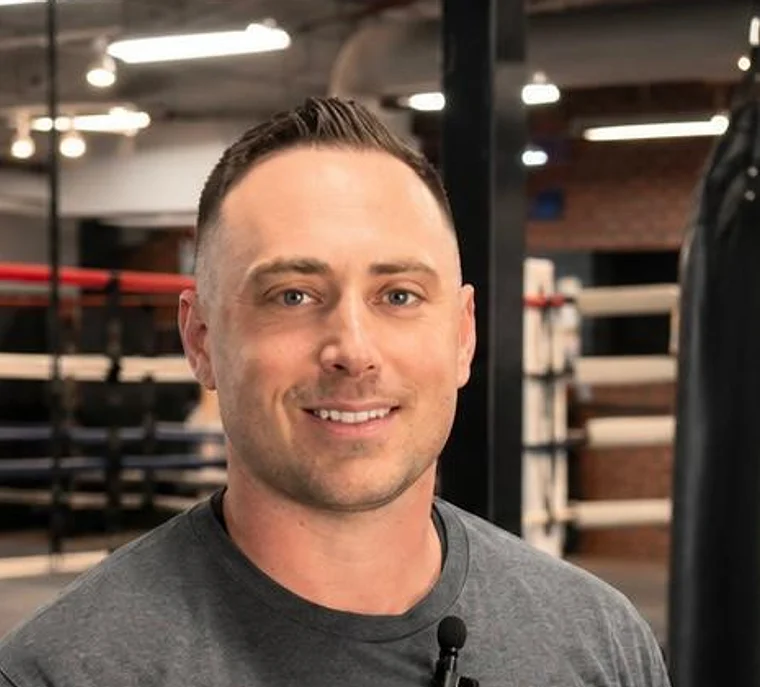
Coach Dean Moskowitz
Owner / Coach, Boxing for Balance — 500+ people with Parkinson's coached