By Coach Dean Moskowitz
Rock Steady Boxing® Gloves & Equipment: What You Actually Need
Health information, not medical advice. Talk with your doctor before starting a new exercise program.
Quick answer: For your first Rock Steady Boxing® class, you need no boxing equipment at all — at my four affiliate gyms, we hand you gloves at the door, and most affiliates do the same. What you actually need on day one: supportive athletic shoes, comfortable clothes you can move in, and a water bottle. If you fall in love with the program (most people do), a pair of your own gloves in the 12–14 oz range with a hook-and-loop closure is a sensible purchase somewhere around week three or four. Everything else on the boxing-store shelf — headgear, mouthguards, sparring gear — you will never need, because nobody gets hit in this program. Here’s the full honest rundown.

Written by an official affiliate coach
I get this question in two forms. Before the first class it’s a nervous “what do I need to buy?” — and the answer is nothing, please don’t buy anything yet. A month in, it’s “okay, I’m hooked, what gloves should I get?” — and that one deserves a real answer, because the boxing-equipment world is built for twenty-five-year-old fighters, not for someone managing Parkinson’s who needs gear that cooperates with stiff fingers and a careful budget.
Day one: what to bring (and what we provide)
At my gyms — Santa Monica, Lake Balboa, Woodland Hills, and Thousand Oaks — your first class is free and gloves are provided. Bring exactly three things:
Athletic shoes with a flat, stable sole. This is genuinely the most important equipment decision in non-contact boxing, and it has nothing to do with boxing. Parkinson’s attacks balance, and your shoes are your foundation for every footwork drill we do. You want a snug fit, a sole that grips, and a heel that doesn’t wobble. Worn-out soles, backless shoes, and thick cushiony running shoes that roll side-to-side all work against you.
Clothes you can move big in. The curriculum is built around large, exaggerated movements — think of it as the opposite of the small, shuffling motion Parkinson’s wants to impose. Anything that lets you punch tall and step wide is right.
Water. Classes are a real workout. The research on boxing for Parkinson’s — including a 2025 systematic review — found strong safety and high adherence, but that’s still sweat-equity you’ll be putting in.
When to buy your own gloves
Somewhere in your first month, buying your own pair starts making sense, for two unglamorous reasons: hygiene (shared gloves are cleaned, but your own gloves are yours) and fit (a glove that matches your hand makes bag work feel dramatically better).
Here’s my coach’s advice for choosing:
Weight: 12–14 oz for most adults. Glove weight is padding, not difficulty. For the bag and mitt work we do, 12 oz suits most smaller-framed boxers and 14 oz suits most others. Heavier sparring gloves (16 oz+) just tire your shoulders for no benefit in a non-contact program.
Closure: hook-and-loop (velcro), always. This is the Parkinson’s-specific advice you won’t get at a boxing store. Lace-up gloves need a second person every single time. A wide velcro strap is something you can manage one-handed, even on a stiff-hand day — and independence is half of what we’re training.
Wrist support over brand names. A firm, supportive wrist cuff protects the joint when you land punches on the heavy bag. Try the glove on, make a fist, press the padded knuckle against a wall gently — your wrist should feel braced, not floppy.
Budget: modest is fine. A $30–50 pair from any reputable sporting-goods brand will outlast years of Rock Steady classes. The $150 fighter gloves are paying for features you’ll never use.
If you want to fly the flag, Rock Steady Boxing, Inc. also runs its own official merchandise store with branded gear — that’s the place for it, and purchases support the nonprofit.
Hand wraps: optional but nice
Traditional cloth wraps take practice and dexterity to put on, which makes them a frustrating chore for many of our boxers. Two easier routes: gel wrap gloves (slip-on padded inner gloves) give you most of the benefit in two seconds, or simply rely on your gloves’ wrist support alone — plenty of my members do, and for our style of bag work that’s fine. If you enjoy the ritual of wrapping (some members find it a good fine-motor warm-up, like a dexterity exercise that happens to be useful), a care partner can learn it in five minutes.
What the gym provides — so you don’t have to
People sometimes ask whether they’ll eventually need their own heavy bag, speed bag, or focus mitts. No. That’s the affiliate’s job. My gyms are stocked with the bags, mitts, cones, and balance equipment the curriculum uses — including the Woodland Hills location inside ZOOZ Fitness, which has a full working gym around it. Your equipment list stays short forever: shoes, clothes, water, gloves, maybe wraps.
If you’re training between classes at home, you need even less — most of the at-home drills I recommend are shadowboxing, footwork, and balance work that use no equipment at all. Please don’t hang a heavy bag off a beam in your garage; that’s how I inherit new members with brand-new injuries.
What NOT to buy
The boxing store will happily sell you all of this. You need none of it:
- Headgear or mouthguards — there is no contact in this program, period. Nobody hits you; you never hit anyone.
- Sparring gloves — same reason.
- Weighted gloves for “extra workout” — they change your punch mechanics and load your shoulders in ways that fight the exact movement quality we’re building. If class ever needs added resistance, that’s my call to make with you, safely.
- Fancy footwork ladders, reflex balls, cognitive-training gadgets — we use versions of these in class, coached. Unsupervised at home, a ladder on the floor is a trip hazard for a person with a balance disorder. Skip it.
A note for seated boxers
If you train from a wheelchair or do most of your rounds seated — and plenty of serious boxers do — the equipment advice barely changes, with two adjustments. First, glove weight matters more, not less: without your legs driving the punch, your shoulders do extra work, so start at 12 oz and let me tell you if moving up makes sense. Second, the velcro-closure rule goes from “recommended” to “non-negotiable,” because you’ll be putting gloves on and off more often as we rotate stations. Everything else — the shoes (yes, still real shoes; they anchor your feet on the footplate), the water, the skip-the-gadgets rule — applies exactly the same.
Caring for your gloves
Boxing gloves live a sweaty life, and a little routine keeps them from becoming a biohazard: pull them open after class so the lining can breathe, let them air-dry at home rather than sealed in a gym bag, and wipe the outside down occasionally. That’s it. A modest pair treated this way lasts years of twice-a-week classes — which makes your own gloves one of the cheapest pieces of exercise equipment, per hour of use, that you’ll ever own.
The one-sentence version
Shoes that grip, clothes that move, water — and let the gym handle the rest until the program has earned a permanent place in your week, at which point a modest pair of 12–14 oz velcro gloves is the only purchase worth making.
Still unsure about anything — glove sizing for small or arthritic hands, footwear for a foot-drop issue, whether your current sneakers pass the test? Bring the question (and the shoes) to your free first class at any of my four gyms and I’ll tell you straight. Call or text 747-234-1115 — your first class is free, gloves included.
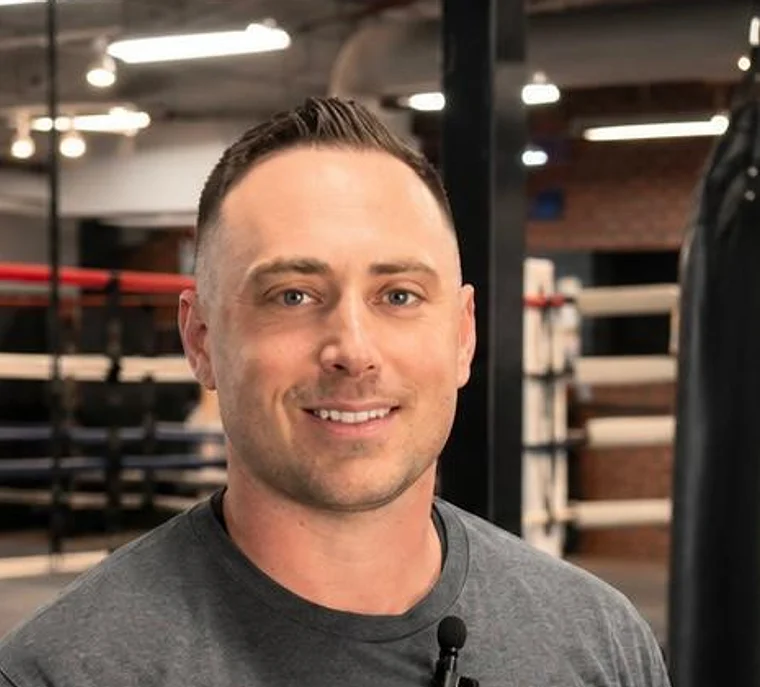
Coach Dean Moskowitz
Owner / Coach, Boxing for Balance — 500+ people with Parkinson's coached