
By Coach Dean Moskowitz
Personal Trainer for Seniors: How to Choose the Right One
Health information, not medical advice. Talk with your doctor before starting a new exercise program.
Quick answer: A good senior personal trainer holds a nationally accredited certification (NASM, ACE, ACSM, NSCA) and ideally a senior-specific credential, has real experience with older bodies and common conditions, and builds sessions around what you want your life to look like — not around a generic template. Expect roughly $50–$120 per session in most areas, less in small groups. A trainer is the right choice when you need individual attention that a class can’t give but you’re past the medical rehab that a physical therapist provides.
There’s a specific kind of frustration I hear from older adults who tried personal training and quit: “He trained me like I was 25 and just slower.”
That’s the whole problem in one sentence. Training an older body isn’t training a young body with lighter weights — it’s a different discipline with different priorities. The goal usually isn’t a bench press number; it’s getting off the floor if you fall, carrying groceries up the steps, and staying in your own home for another decade.
Here’s how to find someone who understands that.
Trainer, class, or physical therapist?
Get this right first, because they solve different problems.
Physical therapist — when there’s a medical reason: recent surgery, a fall, a new diagnosis, real pain, or you’ve been told you’re at high fall risk. PTs are licensed healthcare providers, they can bill insurance (Medicare Part B typically covers medically necessary outpatient PT), and they’ll get you safe before you get strong. Start here if you’re fragile. More in my physical therapy guide.
Personal trainer — when you’re medically stable but need individual attention: you’re nervous about form, you have a specific goal, you need someone to make you show up, or a group setting doesn’t fit your body or schedule. Trainers can’t diagnose or treat conditions, and that’s fine; their job is progressive, personalized exercise.
Group class — when you’re safe on your feet, you want the social energy, and you want to spend a fraction of the money. Often the best long-term home. See my guide to senior exercise classes.
Plenty of people use all three across a year: PT after an event, a trainer to rebuild confidence, then a class to sustain it. That’s a smart arc, not indecision.
The certifications that actually mean something
Anyone can print a business card that says “trainer.” Look for a certification from a nationally accredited organization — the big four are NASM, ACE, ACSM, and NSCA. Any of these means a real exam and continuing education.
Then look for the senior-specific layer: ACE Senior Fitness, NASM Senior Fitness (SFS), ACSM/NCHPAD or Exercise is Medicine training, or the Functional Aging Specialist credential. For Parkinson’s specifically, ask about LSVT BIG training or experience with PD programs — that’s a meaningfully different skill set.
And ask about CPR/AED certification. It should be current. Ask directly; a good trainer won’t be offended.
Questions to ask before you hire anyone
- “How many clients over 65 do you currently train?” You want a number, not a warm feeling. If it’s one or two, keep looking.
- “Have you worked with [your condition]?” Arthritis, osteoporosis, Parkinson’s, neuropathy, joint replacements, heart conditions — be specific, and listen for specifics back.
- “What would our first session look like?” The right answer includes an assessment — balance, strength, how you move, what you want to be able to do. If session one is a workout with no assessment, that’s a red flag.
- “How do you handle a day when I feel terrible?” Older bodies have variable days, especially with Parkinson’s. You want someone who adapts, not someone who pushes through everything.
- “Will you talk to my doctor or physical therapist?” Great trainers are happy to coordinate.
- “What are your rates, and do you offer semi-private sessions?” Two or three people sharing a trainer costs far less each and adds accountability.
- “Can we do a trial session?” Personality fit matters more than most people admit. You’re going to be sweaty and occasionally frustrated in front of this person.
Red flags
- Selling supplements. Hard no. A trainer’s job is exercise.
- No assessment, no questions about your health history. Reckless.
- “No pain, no gain” language — with older bodies, that philosophy causes injuries and quitting.
- Pressure to buy a big package upfront before you’ve had a single session.
- Ignoring your goals in favor of their program.
- Treating you as fragile. The opposite failure, and just as bad. You want challenged-and-safe, not coddled.
- Any promise to “cure” a condition. Exercise helps enormously. It isn’t a cure, and honest professionals say so.
What it costs, and how to spend less
Rates vary by region and experience, but roughly $50–$120 per session is typical for one-on-one, with major metro areas at the higher end. Ways to reduce that:
- Semi-private training (2–4 people): often half the per-person cost, and the small group makes it more fun.
- Fewer sessions, spaced out. Twice a month with a good program to do on your own works well for motivated people.
- Front-load, then taper. Weekly for six weeks to learn form, then monthly check-ins.
- Check your Medicare Advantage fitness benefit. It won’t usually cover personal training, but it may cover the gym and classes — call the number on your card and ask.
- Ask about home sessions if travel is the barrier — many trainers, including us, will come to you.
What good senior training actually looks like
Sessions should be built around your life. If your goal is “carry laundry up the basement stairs,” you’ll do step-ups and carries. If it’s “get off the floor if I fall,” you’ll practice floor transfers. If it’s “keep dancing at weddings,” you’ll train balance and endurance.
Expect: a real warm-up, sit-to-stand and leg strength work (the foundation of independence), pushing and pulling for the upper body, balance training every session, and progression that’s steady but unmistakable. Expect your trainer to write things down and to show you what you’re improving on. Expect to be asked how last week’s soreness went.
And expect the exercises to look like life, not like a bodybuilding magazine.
If you’re in Los Angeles or Ventura County
I do private training for seniors and people with Parkinson’s — at our gyms, in your home, or online — with the same amplitude, balance, and strength focus that runs through our group classes. If a group is a better fit for you, I’ll tell you that honestly, and your first class is free either way.
Call or text me at 747-234-1115, or reach out here. And if you’re somewhere else in the country, use the questions above — they’ll find you a good one.
Dean Moskowitz is the head coach at Boxing for Balance. He has spent more than ten years helping over 500 people with Parkinson’s — and hundreds of older adults — build strength through non-contact boxing and exercise, in classes across Los Angeles and Ventura County.
Sources: CDC physical activity guidance for older adults · ChoosePT — American Physical Therapy Association · Medicare.gov · CDC — Facts about falls
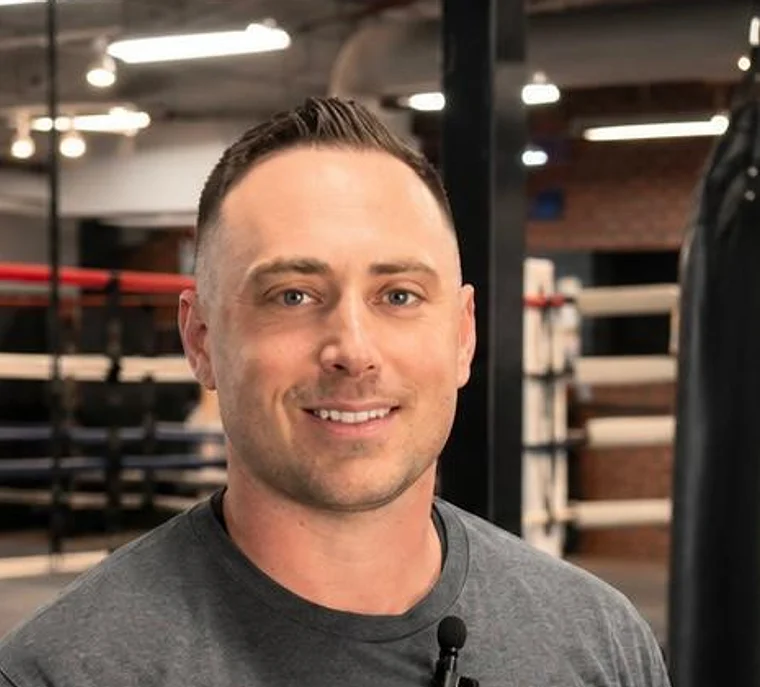
Coach Dean Moskowitz
Owner / Coach, Boxing for Balance — 500+ people with Parkinson's coached