
By Coach Dean Moskowitz
Movement Is Medicine — But Only the Doses You Actually Take
Health information, not medical advice. Talk with your doctor before starting a new exercise program.
Quick answer: Exercise is one of the most powerful things available in Parkinson’s care — the Parkinson’s Foundation recommends at least 2.5 hours a week, and starting early matters. But a prescription only works if it’s filled. The reasons people stop are rarely laziness: apathy affects around 40% of people with Parkinson’s, isolation is common and tracks with worse symptoms, and fatigue is real. That’s why the program you enjoy, with people who expect you, beats the theoretically perfect program you quit in March.
“Movement is medicine” is the line I say most often, and I mean it literally — not as encouragement, but as the reason my classes exist.
Here’s what I’ve learned in ten years of saying it, though: everybody already knows exercise helps. Nobody walks into my gym needing convincing. What they need is a way to still be exercising next spring, and that turns out to be a completely different problem from knowing you should.
So this post is about the second problem. It’s the one that actually decides outcomes.
The medicine part is real
Start with what’s not in dispute. The Parkinson’s Foundation recommends at least 2.5 hours of exercise per week for people with Parkinson’s, across four categories: aerobic work, strength, balance and agility, and stretching. Their guidance is also clear that establishing the habit early after diagnosis is associated with better outcomes down the road.
And the intensity question has real evidence behind it. In the SPARX trial published in JAMA Neurology, people newly diagnosed and not yet on medication were assigned to high-intensity treadmill exercise (80–85% of maximum heart rate, four days a week for six months), moderate-intensity exercise, or usual care. After six months the high-intensity group’s motor scores had barely moved — a 0.3-point change — while the usual-care group worsened by 3.2 points.
Two honest caveats belong right next to that. SPARX was a phase 2 trial with 128 people, designed to test feasibility and justify a larger trial rather than settle the question. And 80–85% of maximum heart rate is genuinely hard work that most people need to build toward, with a doctor’s sign-off. The takeaway isn’t “go all out tomorrow.” It’s that effort appears to matter, not just attendance.
I break the weekly targets down properly in Parkinson’s exercise: how much, how often, and what kind.
The dose you don’t take does nothing
Now the part nobody puts on a fact sheet.
A prescription that sits in the drawer has an effect size of zero. And with Parkinson’s, the disease itself is actively working to keep that drawer shut:
Apathy. A meta-analysis in Movement Disorders pooling 23 studies and 5,388 people found apathy affects about 39.8% of people with Parkinson’s — and about half of those people aren’t depressed. Apathy specifically damages the machinery that turns intention into action. It is, precisely, a motivation disorder. Telling someone with apathy to “stay motivated” is like telling someone with a tremor to hold still. (More on apathy here.)
Isolation. In a survey published in npj Parkinson’s Disease, people with Parkinson’s who reported being lonely also reported 55% greater symptom severity than those who weren’t. Lonely people don’t drive themselves to gyms. (More on that here.)
Fatigue. Not sleepiness — a depletion that makes a 10 a.m. class feel like a mountain at 9:40.
Look at that list and you’ll notice something: these aren’t character failures. They’re symptoms. Which means the fix isn’t more discipline. It’s designing around them.
Why I train people the way I do
Everything about how my classes run is an answer to that problem.
Fun first, unapologetically. Music on, gloves up, people laughing. Not because the exercise matters less, but because enjoyment is what gets someone through the door on the morning the disease says no. A slightly-less-optimal workout you do 120 times a year beats a perfect one you do 11 times.
Same time, every week. Motivation is the broken part in a lot of people I coach, so I don’t ask people to supply it. Tuesday at 10 is the boxing day. Nobody has to decide anything.
People who notice you’re missing. This is the strongest adherence tool I have, and I didn’t invent it — I just watched it work. When somebody misses two weeks, three people text them. That’s not a business strategy, that’s what happens in a room where people know each other.
Hard, but scaled to you. Everything can be done seated or standing. Everyone in the room is working near their own ceiling, which is what the intensity research points to — and nobody is being compared to the person next to them.
Fighting Parkinson’s is a team sport
You don’t have to do this alone, and the evidence increasingly suggests you shouldn’t try.
In my gyms we are a team, and the team quickly becomes a family. The people around you know exactly what a hard day feels like — and they’ll be the loudest ones celebrating your good days. I’ve watched members drive each other to class, sit in the parking lot afterward talking for an hour, and show up to each other’s birthdays.
I’ll be honest about the limits of that, though, because I’ve written about it elsewhere and I’m not going to oversell it here. A 2026 study in the Journal of Neurologic Physical Therapy found that among 231 people with Parkinson’s already attending community exercise classes, about a third still scored as lonely. Showing up is not the same as connecting. The room is an opportunity, not a guarantee — you still have to talk to somebody.
What to do with all this
If you’re deciding how to start, the order that actually works:
- Pick something you don’t dread. Boxing, dance, cycling, water aerobics, walking with a friend. The best program is the one still happening in six months.
- Put it on a schedule someone else keeps. A class, a standing appointment, a person picking you up. Do not rely on how you feel that morning.
- Aim for the 2.5 hours, but start smaller. Two days is a real start. Nobody ever built a habit out of an ambitious plan they abandoned in week two.
- If you can’t get started at all, that’s medical information. Apathy and depression are treatable symptoms. Tell your neurologist — that conversation may do more for your exercise routine than any advice I can give you.
Movement is medicine. But medicine only works if you take it, and the whole art of this is building a life where taking it is the easy option.
Come move with us if you’re nearby — the first class is free, in person or online. And if you go somewhere else entirely and stick with it, I’ll count that as a win.
Dean Moskowitz is the head coach at Boxing for Balance. A lifelong martial artist and former MMA fighter, he has spent more than ten years helping over 500 people with Parkinson’s — and hundreds of older adults — build strength through non-contact boxing and exercise, in classes across Los Angeles and Ventura County.
Sources: Parkinson’s Foundation — Exercise Recommendations · SPARX high-intensity treadmill trial (JAMA Neurology, 2018) · Apathy in Parkinson’s — systematic review and meta-analysis (Movement Disorders, 2015) · Social isolation and Parkinson severity (npj Parkinson’s Disease, 2020) · Loneliness in people with Parkinson disease in community-based exercise (J Neurol Phys Ther, 2026)
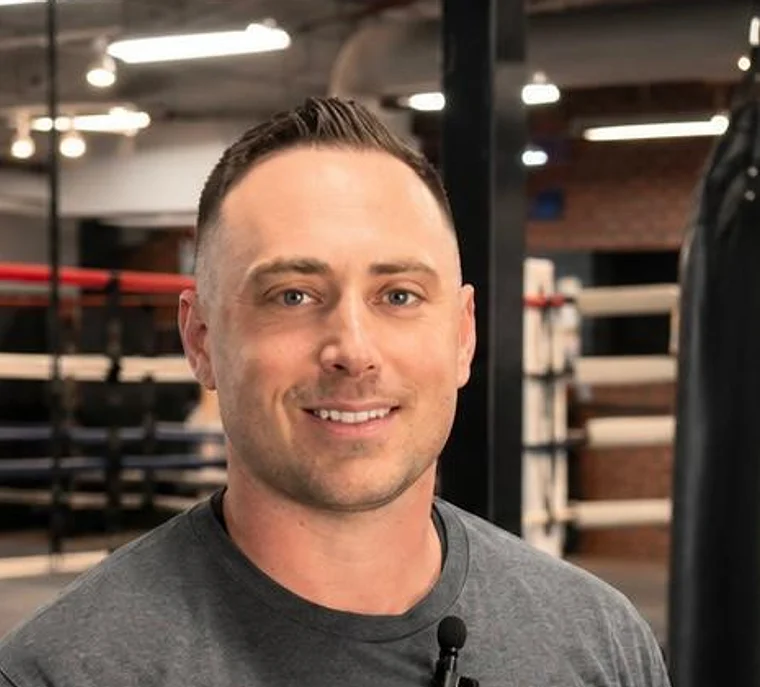
Coach Dean Moskowitz
Owner / Coach, Boxing for Balance — 500+ people with Parkinson's coached