
By Coach Dean Moskowitz
Memory Care Activities That Actually Engage: A Coach's List
Health information, not medical advice. Talk with your doctor before starting a new exercise program.
Quick answer: The memory care activities that work best share three traits: they use the body more than the memory, they succeed at every ability level, and they connect to who the person was — their music, their work, their roles. Below is a working list — movement, music, sensory, purpose, and connection activities — drawn from ten years of teaching weekly classes in memory care communities, plus the honest signs that tell you an activity is landing or failing.
I teach boxing in memory care communities every week — places like the ones across Los Angeles and Ventura County where I’ve coached for a decade. Yes, boxing. Residents with dementia put on gloves, hit pads, and grin like they’re twenty again.
If that surprises you, you’ve discovered the most important thing about memory care activities: the body remembers what the mind has trouble reaching. A woman who can’t recall her daughter’s visit an hour ago can still throw a jab-cross combination to a Sinatra song, because rhythm and movement live in older, sturdier parts of the brain than names and dates do.
Whether you’re an activity director, a caregiver, or a family member planning visits, here’s what actually engages people — organized by what each activity reaches for.
Movement activities (the body remembers)
Movement is the backbone of a good activity calendar — it lifts mood, protects strength, and needs no memory at all to enjoy.
- Seated boxing. Loose fists, big punches, music with a beat. I’ve watched non-verbal residents light up mid-combination. Whatever movement you lead, make it mirrored — you do it, they follow — with no instructions longer than three words. “Punch! Big one! Again!” (Here’s what a seated boxing workout really involves, and how I run them in senior communities.)
- Balloon volleyball. A balloon, a circle of chairs, done. It’s failure-proof — the balloon is slow enough that everyone succeeds — and it produces more laughter per minute than anything else I’ve seen in an activity room.
- Parachute or scarf games. Everyone holds the edge, waves it to music. Group movement without a single instruction.
- Walking clubs. A short loop, same route every time (familiarity is a feature, not boredom), narrating what you see. The route becomes an old friend.
- Chair dancing and rhythm shakers. Put on their era’s music and move. See the music section — it’s the strongest tool in the room.
- Gentle stretching to slow music. Especially good in late afternoon, when agitation often rises.
A note on the exercise itself: seated routines genuinely build strength in older adults — research across 1,388 participants found real gains from chair-based exercise. My caregiver’s guide to seated exercises has a full routine you can lead.
Music activities (the last door to close)
Musical memory survives deep into dementia — ask any activity director who’s watched a resident who no longer speaks sing every word of a hymn from 1955.
- Personal playlists. The single highest-value activity on this page. Learn what they loved at age 15–30 and play that — not “oldies” generally, their songs. Families can build these playlists better than anyone.
- Sing-alongs with lyric sheets in big print. Pick songs from their young adulthood.
- Live music of almost any quality. A volunteer with a guitar beats a perfect recording. Live-ness itself is the event.
- Rhythm instruments. Shakers, tambourines, drums on tray tables. Rhythm needs no memory.
- Music paired with movement — which is exactly why my boxing classes run to a soundtrack. The beat does half my coaching for me.
Sensory activities (when words step back)
As dementia advances, the senses stay open long after conversation gets hard.
- Hand massage with scented lotion. Touch plus lavender plus undivided attention. Ten minutes, enormous return.
- Sensory bins: a basin of dried beans with hidden objects to find, fabric squares of different textures, a box of old kitchen tools to handle and sort.
- Baking for the smell of it. Bread machine or cookies in the community kitchen — the point is the aroma filling the room and the tasting after.
- Gardening. Potting succulents, watering, deadheading flowers. Dirt under the fingernails is its own kind of memory.
- Pet visits. Therapy dogs, or a staff member’s gentle cat. Watch hands that rarely move start stroking fur.
Purpose activities (everyone needs a job)
The deepest ache in memory care isn’t boredom — it’s uselessness. People who ran households and businesses for fifty years still need to be needed.
- Folding towels and washcloths. Not busywork — real towels the community really uses. The repetition is soothing and the contribution is real.
- Setting tables, sorting mail, watering plants — small daily jobs, assigned like they matter, because they do.
- Skill echoes. The retired carpenter sands a piece of wood. The former secretary “files” papers. The lifelong cook tears lettuce for the salad. Learn the résumé; it’s an activity map.
- Helping each other. Pushing a friend’s wheelchair to lunch, handing out song sheets. Purpose plus friendship in one move.
Connection activities (visits that go somewhere)
For families especially — these turn a hard visit into a good one.
- Old photos, asked about sideways. Never “Do you remember…?” (a quiz they may fail). Instead: “Tell me about this car.” Statements and open doors, not tests.
- Reminiscence kits: a shoebox of era objects — a rotary dial, a recipe card, a service medal. Objects start stories that questions can’t.
- Reading aloud — poetry, Psalms, short pieces with rhythm. Being read to is comfort with zero demands.
- Simple games without scorekeeping: dominoes for the clacking and sorting, big-piece puzzles, card matching. The doing matters; the winning is abolished.
How to tell if an activity is working
Forget completion. Watch for: leaning in, humming, hands joining, softened faces, the room getting louder in a happy way. An activity “fails” when it quizzes memory, moves too fast, has too many steps, or treats grown adults like children — the fastest way to lose a room of people who can absolutely tell they’re being condescended to, even when they can’t say so.
And when someone declines? Invite, don’t insist; come back in five minutes; or just start the activity nearby where they can see it. Curiosity recruits better than persuasion. (More on gentle encouragement in my caregiver’s guide — the same principles apply to everything on this page.)
For activity directors: bringing programs in
The communities I work with — from large groups like Belmont Village and Silverado to single neighborhood homes — mix staff-led activities with visiting programs: musicians, pet teams, art teachers, and movement coaches like me. If you’re building a calendar in the LA or Ventura County area and want a boxing program your residents will genuinely look forward to, here’s what I offer communities, or call or text me at 747-234-1115. For families navigating a Parkinson’s diagnosis alongside dementia, the Parkinson’s Foundation Helpline at 1-800-4PD-INFO (1-800-473-4636) is free and endlessly helpful.
The goal, always, is the same one I chase in every class: not to fill an hour, but to fill the person. On a good afternoon, with the right song and a pair of red gloves, you can watch it happen.
Dean Moskowitz is the head coach at Boxing for Balance. He has spent more than ten years helping over 500 people with Parkinson’s — and hundreds of older adults — build strength through non-contact boxing and exercise, including weekly seated boxing classes in assisted living and memory care communities across Los Angeles and Ventura County.
Sources: Chair-based exercise systematic review and meta-analysis (Int J Environ Res Public Health, 2021) · CDC physical activity guidance for older adults
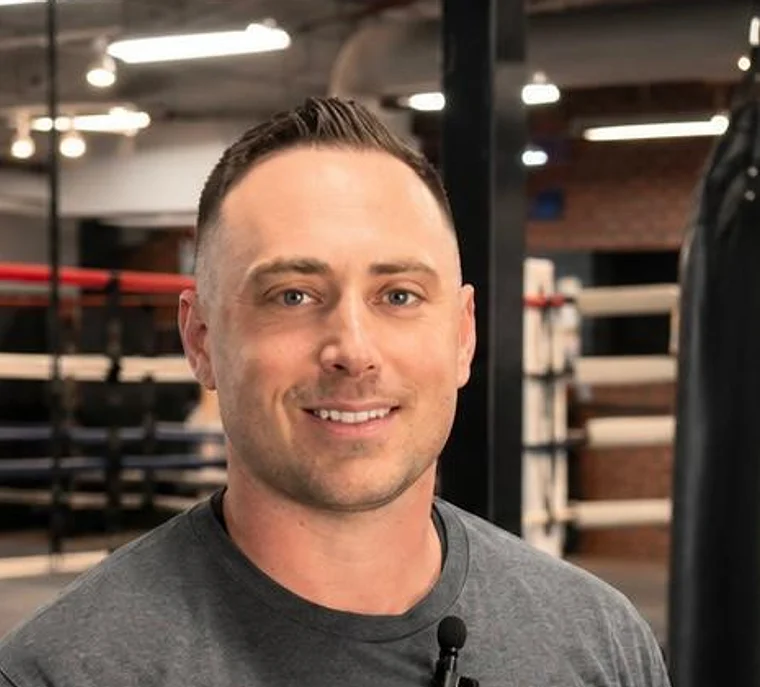
Coach Dean Moskowitz
Owner / Coach, Boxing for Balance — 500+ people with Parkinson's coached