
By Coach Dean Moskowitz
A Home Workout for Seniors: Full Body, No Equipment
Health information, not medical advice. Talk with your doctor before starting a new exercise program.
Quick answer: You can get a complete workout at home with a sturdy chair, a bit of wall space, and about 30 minutes. The routine below covers all four things an older body needs — a warm-up, strength work, balance practice, and stretching — with an easier and harder version of every exercise. Do it three times a week and you’re meeting the strength portion of the CDC’s activity guidelines for older adults without ever leaving the house.
Some of the strongest people I coach barely ever set foot in a gym.
They exercise in kitchens and living rooms, between the couch and the coffee table, in the same spot every morning because that’s where the habit lives. After ten years of coaching people from age 62 to over 100 — in person and through my online program — I can tell you the location of a workout matters far less than the showing up.
So here’s a complete home workout, written the way I’d coach it if I were standing in your living room.
Before you start: the two-minute setup
- A sturdy chair with armrests — dining chair, not recliner, no wheels.
- Clear floor space — kick the rug corner flat, move the dog bed.
- A wall or countertop within reach for balance work.
- Water nearby. You’re going to earn it.
- Shoes on, even indoors. Socks on hard floors is how good workouts end badly.
Do this workout at the time of day you feel best. For many of my members that’s mid-morning, after breakfast and coffee have done their work.
Part 1: Warm-up (5 minutes)
Never skip this. Cold muscles are grumpy muscles.
- March in place — 2 minutes. Hold the chair back if you like. Lift those knees, swing those arms.
- Shoulder rolls — 30 seconds, then arm circles — 30 seconds. Big slow circles, both directions.
- Gentle twists — 1 minute. Hands on hips, rotate side to side.
- Ankle circles — 1 minute. One foot at a time, holding the chair. Ten circles each way, each foot.
Part 2: Strength (12 minutes)
Do each exercise for about 45 seconds, rest 15, then move to the next. Go through the whole list twice.
1. Sit-to-stand. Sit tall, scoot forward, stand up, sit down with control. Easier: push off the armrests. Harder: arms crossed over chest. This is the king of exercises for staying independent — it’s the same movement as getting off the toilet and out of the car, and it’s the first thing I test with every new member.
2. Wall push-up. Hands on the wall at shoulder height, walk your feet back a step, lower your chest toward the wall, push back. Easier: stand closer. Harder: step farther back.
3. Standing march with a hold. Holding the chair back, lift one knee and hold it up for a slow count of three. Alternate. Easier: smaller lift, both hands on the chair. Harder: fingertips only.
4. Counter punches. Stand (or sit) tall and throw slow, controlled punches at chest height — like my members do in class. Exhale sharply with each punch. Harder: hold a can of soup in each fist. Congratulations, you now own dumbbells.
5. Heel raises. Holding the chair, rise up on your toes, lower slowly. Harder: pause two seconds at the top.
6. Seated knee extension. Sitting tall, straighten one leg, hold one breath, lower. Alternate legs.
Part 3: Balance (6 minutes)
Do these near the wall or counter. Balance is a skill, and skills need practice — this is the section that helps your feet catch you when the rug doesn’t cooperate. (For the CDC’s sobering numbers on falls — one in four adults 65+ falls each year — and a deeper set of drills, see my full guide to balance exercises for seniors.)
- Narrow stance stand — 1 minute. Feet together, hands hovering over the counter. Steady breathing.
- Heel-to-toe stand — 1 minute. One foot directly in front of the other like a tightrope. Switch feet halfway.
- Weight shifts — 2 minutes. Feet wide, shift your weight slowly left, center, right. Like a slow-motion boxer’s sway — this is exactly the footwork foundation we teach in class.
- Single-leg stand — 2 minutes. Lift one foot an inch off the floor. Hold up to 10 seconds. Switch. Always within reach of the counter.
Part 4: Stretch and breathe (5 minutes)
- Reach for the sky — 30 seconds. Both arms overhead, stretch tall like you’re picking fruit.
- Chest opener — 1 minute. Hands clasped behind you (or just squeeze shoulder blades together), lift your chest. This one fights the day-long hunch of sitting.
- Seated hamstring stretch — 1 minute each leg. Sitting, extend one leg with the heel on the floor, hinge gently forward until you feel the back of the thigh.
- Slow breathing — 1 minute. In through the nose for four, out through the mouth for six.
Done. That’s a genuine full-body workout — strength, balance, mobility, and a calmer nervous system, in about half an hour.
How often, and how to make it stick
The CDC’s guidance for adults 65 and older comes down to: move most days (150 minutes a week of moderate activity), strengthen your muscles at least twice a week, and practice balance. This workout three times a week, plus walking on the other days, checks every box.
The making-it-stick part is where most home routines die, so steal my members’ tricks:
- Same time, same spot, every time. Habit loves geography. The workout lives next to the brown chair at 9 a.m., period.
- Put it on the calendar like a doctor’s appointment. Because it is one, sort of — it’s just preventive.
- Tell one person. A spouse, a friend, a kid who calls on Sundays. “Did you do your workout?” is a powerful little question.
- Track it stupidly simply. An X on the kitchen calendar. Don’t break the chain.
- Miss a day? Fine. Miss two? Do the warm-up only — five minutes — just to keep the habit’s heartbeat going. Something always beats nothing.
When home isn’t quite enough
A home workout is a foundation, not a ceiling. If you have Parkinson’s, you’ll want more targeted work — start with my guide to Parkinson’s exercises at home or the exercise guidelines. If you’d like real coaching without leaving the house, my online program adds two new follow-along workouts every week, and private training can happen in your home or over video.
And if you’re within reach of Los Angeles or Ventura County — come punch things with us. First class is free, no strings: schedule here or call 747-234-1115.
But honestly? Start with the brown chair and the wall. They’re undefeated.
Dean Moskowitz is the head coach at Boxing for Balance. He has spent more than ten years helping over 500 people with Parkinson’s — and hundreds of older adults — build strength through non-contact boxing and exercise, in classes across Los Angeles and Ventura County.
Sources: CDC physical activity guidance for older adults · CDC — Facts about falls · Chair-based exercise systematic review (Int J Environ Res Public Health, 2021)
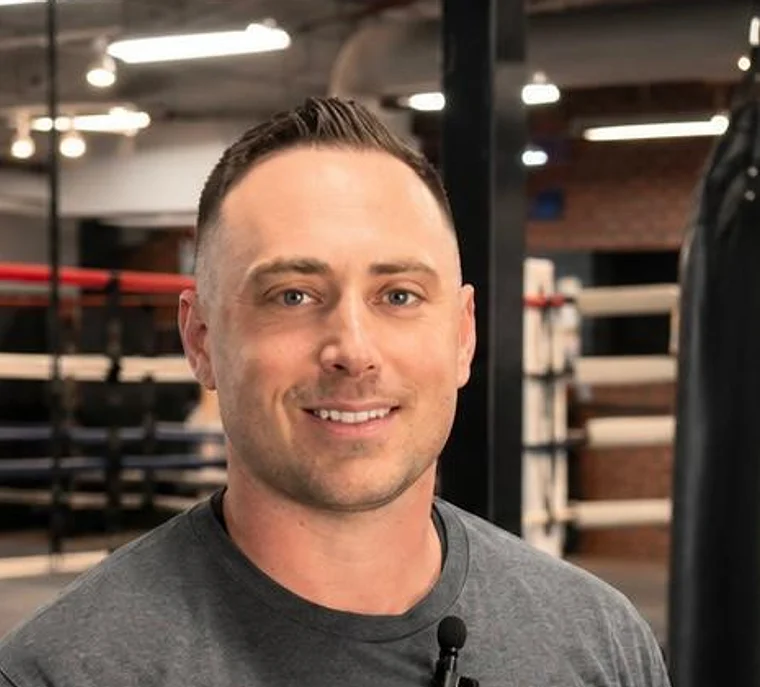
Coach Dean Moskowitz
Owner / Coach, Boxing for Balance — 500+ people with Parkinson's coached